Shopify Email Deliverability & Inbox Placement
An email that lands in spam converts at zero, no matter how good the copy is. We set up SPF, DKIM and DMARC properly on a dedicated sending domain, bring you into line with Google and Yahoo's bulk-sender requirements, clean up the list behaviour that's damaging your reputation, and then monitor placement instead of assuming it.
Book a Free Technical Call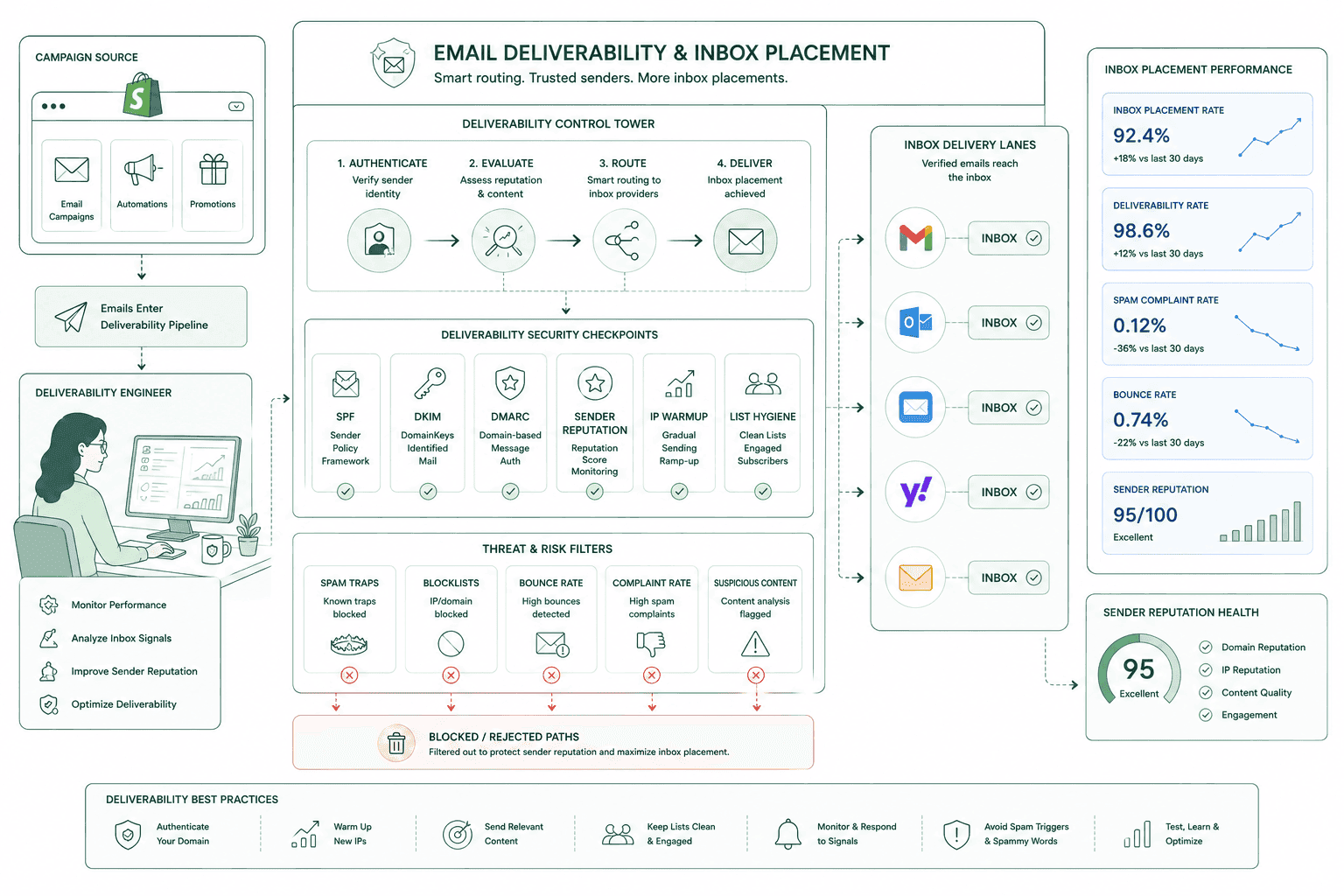
Why it matters
Deliverability isn't a setting. It's a reputation you've either built or damaged.
Mailbox providers decide where your email goes using signals you generate over time: how many people open it, how many delete it unread, how many mark it as spam, how many addresses bounce, and whether the message is authenticated well enough to prove it came from you. In February 2024 Google and Yahoo turned much of this from best practice into a requirement for bulk senders — SPF, DKIM and DMARC, one-click unsubscribe, and a spam-complaint rate kept below 0.3%. Plenty of Shopify stores are still sending as though that never happened. The uncomfortable part is that reputation recovers slowly. Damage takes weeks to accumulate and weeks more to undo, which is why this work is remediation rather than a switch.
Sound familiar?
Inbox placement usually degrades quietly before anyone notices.
None of these prove you're in spam on their own. Several together nearly always mean placement has already slipped.
- Open rates dropped sharply and nothing about your sending or creative changed.
- Gmail subscribers stopped responding while other providers look roughly normal.
- Your own test sends land in Promotions or Spam when you check a fresh inbox.
- You've never opened Google Postmaster Tools and don't know your domain reputation.
- You assume a dedicated IP fixes deliverability, regardless of how much you send.
- You're still emailing subscribers who last opened something well over a year ago.
What's included
What the deliverability engagement covers
The technical setup, the list behaviour behind it, and the monitoring that tells you whether any of it worked.
SPF, DKIM and DMARC done properly
Authentication configured on a dedicated sending subdomain, with a DMARC policy that starts at monitoring and moves toward enforcement once the reports are clean. Half-configured DMARC is common — a record exists, nothing is aligned, and nobody has ever read a report.
A dedicated sending domain
Marketing email sent from a subdomain rather than your root domain, so a bad campaign run can't take your order confirmations and support replies down with it. Separating transactional from marketing streams is one of the cheapest protections available.
Bulk-sender compliance
Google and Yahoo's 2024 requirements checked line by line: authentication in place, one-click list-unsubscribe headers present and working, valid forward and reverse DNS, and complaint rate monitored against the 0.3% threshold. These are published requirements, not opinions.
List hygiene and sunsetting
Hard bounces removed, role addresses and obvious junk signups filtered at the form, and a standing sunset policy that retires profiles who've ignored you for a defined period. Continuing to email people who never engage is the single most common self-inflicted deliverability wound.
Shared versus dedicated IP
An honest recommendation rather than a default. A dedicated IP only helps when you send enough volume, consistently, to establish a reputation on it. Below that, a shared pool carries you on other senders' good behaviour, and a dedicated IP will make placement worse rather than better.
Monitoring with Postmaster Tools
Google Postmaster Tools connected and read regularly: domain reputation, spam rate, authentication pass rates and delivery errors. Without it you're inferring inbox placement from open rates, which Apple Mail Privacy Protection made an unreliable proxy years ago.
How it runs
How deliverability remediation runs.
Authentication and configuration take two to four weeks. Reputation recovery is slower — expect four to eight weeks before placement genuinely stabilises, because mailbox providers change their mind about you gradually.
- 01
Diagnose the damage
Authentication records checked, Postmaster Tools reviewed, complaint and bounce history pulled, and seed testing across major providers so we know where mail is landing today rather than guessing.
- 02
Fix the technical layer
SPF, DKIM and DMARC configured correctly on a dedicated sending subdomain, list-unsubscribe headers verified, and transactional mail separated from marketing so one stream can't damage the other.
- 03
Clean and warm
Bounces and long-term non-openers removed, sunset policy switched on, then volume rebuilt gradually to your most engaged subscribers first so early sends generate the signals providers want.
- 04
Monitor and hold
Weekly review of domain reputation, spam rate and authentication pass rates, with frequency and segment rules adjusted whenever the numbers move. This is a standing discipline, not a completed task.
3
DNS records set
SPF, DKIM and DMARC
< 0.1%
Spam-rate target
Google hard-fails at 0.3%
2–4 wks
Technical fix
Auth and sending domain
4–8 wks
Reputation recovery
Slower than the fix
Straight answer
Deliverability work only holds if the sending behaviour changes too.
A good fit if…
- Engagement fell noticeably and you want the cause diagnosed rather than the subject lines rewritten.
- You're sending at bulk volumes without DMARC, and Google's requirements now apply to you.
- You're migrating platforms or domains and want warming planned before the first send.
- Marketing and transactional email currently share a domain, and you understand the risk.
Probably not, if…
- You bought or scraped the list. We won't try to make that deliverable.
- You want the technical fix but intend to keep emailing unengaged subscribers weekly.
- You want a guarantee of inbox placement. Nobody can honestly offer one.
- You want a dedicated IP because it sounds better, on volume that can't sustain it.
Keep exploring
More on Shopify email marketing
Deliverability & Inbox Placement is one part of how we run Shopify email programmes. Here's the rest of the picture.
Shopify Email Marketing & Klaviyo
The complete service — every flow, campaigns, segmentation and deliverability.
View the serviceClosely relatedSegmentation & Predictive AI
Engaged-only sending is the segmentation half of the deliverability fix.
Read the guideClosely relatedCampaign Strategy & Sends
Send frequency and audience selection decide whether the technical fix holds.
Read the guideAll guides in this series
- Abandoned Cart FlowThe highest-earning flow in ecommerce, and the one most stores leave on defaults.
- Welcome SeriesFirst impression and first purchase — the flow every new subscriber sees.
- Browse AbandonmentCatch intent before a cart exists, without emailing everyone who blinked.
- Post-Purchase & ReplenishmentTurn a first order into a second one, timed to how the product is actually used.
- Winback & Re-engagementReach lapsed customers before they cost you deliverability by ignoring you.
- VIP & Loyalty FlowsIdentify the customers worth protecting, then treat them differently.
Beyond this service
Other things we do
Most stores need two or three of these working together. Book a call and we'll tell you which ones actually move your numbers.
- Shopify Theme DevelopmentCustom themes built from Figma to production Liquid on Online Store 2.0 — fast and merchant-editable.
- Shopify App DevelopmentCustom and public apps, Checkout UI Extensions and Shopify Functions built with React and Polaris.
- Shopify MigrationMove from WooCommerce, Magento or BigCommerce with a full 301 redirect map and zero downtime.
- Shopify SEOTechnical audits, Core Web Vitals, structured data and collection content built around buyer intent.
- Shopify Performance OptimizationFaster load times and green Core Web Vitals — theme refactors, image pipelines and app cleanup.
- Shopify A/B TestingHypothesis-led experiments on product pages and checkout, shipped as native theme code.
- Shopify Email Marketing & KlaviyoFlows, segmentation and campaigns — welcome, abandoned cart, winback and SMS, built and monitored.
- Shopify CRO & FunnelsValue-ladder, tripwire, quiz and post-purchase upsell funnels built to lift conversion and AOV.
- Shopify Maintenance & SupportRetainers covering uptime monitoring, security patching, bug fixes and proactive improvements.
Frequently asked questions
- No, and treat anyone who does with suspicion. Mailbox providers make placement decisions using signals we influence but don't control, and they change their filtering constantly. What we can do is remove every reason they have to distrust you: correct authentication, compliance with published bulk-sender requirements, a clean list, sensible frequency and continuous monitoring so problems get caught in weeks rather than quarters. That's the honest version of the service.
Landing in spam?
Book a 30-minute call. We'll check your authentication records and Postmaster Tools data, and tell you whether this is a technical problem or a sending-behaviour one.
Book a free call