Migrate to Shopify from anywhere.
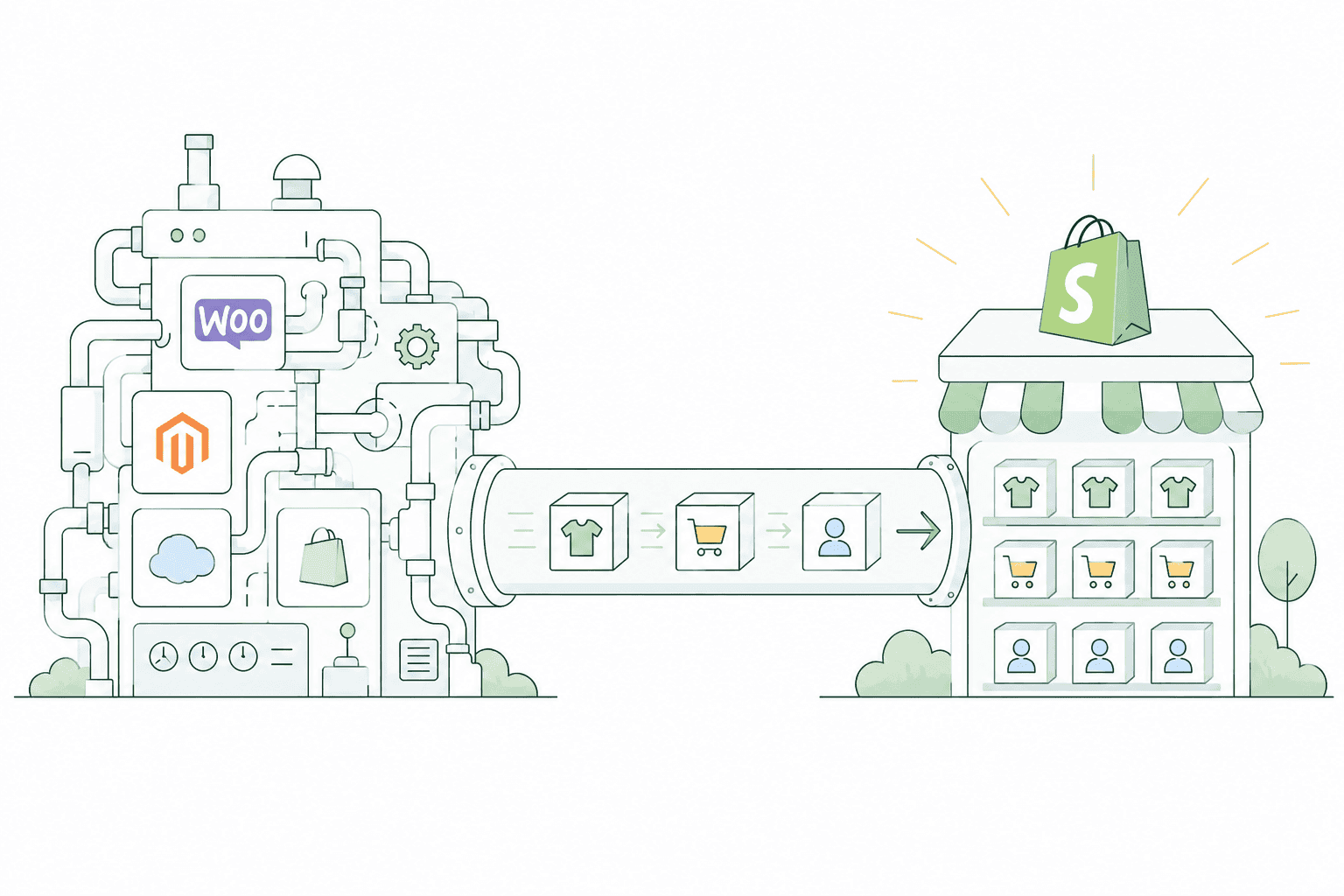
WooCommerce, Magento, BigCommerce, Salesforce Commerce Cloud — and a dozen others. We move products, customers, and order history intact, map every URL to a 301 redirect, and preserve your SEO — so you migrate to Shopify with zero downtime and without losing rankings, traffic, or a single sale.

Migrating to Shopify from your platform
Every platform migration has its own SEO traps. Here's what changes — and what we protect — when you move to Shopify from the most common platforms.
What gets migrated
Nothing important gets left behind.
We move every piece of operational data your store needs to run on day one — and we test every single flow on staging before you sign off.
Products & variants
Every SKU, option, image, and inventory level.
Customer accounts
Profiles and hashed passwords — no resets needed.
Order history
Years of orders for support and post-purchase lookups.
301 redirects
Every old URL mapped to its new equivalent.
Metadata & schema
Titles, descriptions, structured data — SEO preserved.
App parity mapping
Each plugin/extension matched to its Shopify equivalent.
Payment & tax
Gateways, rates, and regional rules reconfigured cleanly.
Shipping rules
Zones, carriers, and rates rebuilt to match.
Reviews
Product reviews ported to Judge.me, Loox, or Yotpo.
What goes wrong in a migration — and how we prevent it
Most migration horror stories come down to a handful of avoidable mistakes. Here's what kills organic revenue in a move — and exactly how we protect against each.
Lost rankings & traffic
Change URLs without redirects and Google drops the old pages — 30–50% of organic traffic can vanish overnight.
How we prevent it: Ranking baselines, a full 301 redirect map, and Search Console monitoring for 60 days.
Broken redirects
A redirect map full of chains, loops, or wrong targets leaks link equity and frustrates shoppers.
How we prevent it: Every redirect tested for chains and loops, then verified in server logs before cutover.
Lost data
Products, customers, and years of order history can arrive incomplete — or not at all.
How we prevent it: Products, variants, customers (with passwords), and full order history migrated and reconciled.
Downtime & lost sales
A messy cutover takes your store offline during your busiest selling hours.
How we prevent it: We build and QA on staging, then flip DNS with redirects already live — zero downtime.
Duplicate content
Faceted collections, variants, and legacy sitemaps create duplicate URLs that dilute rankings.
How we prevent it: Canonical rules, clean XML sitemaps, and index controls set before launch.
Broken checkout & tracking
Forms, carts, and analytics silently break, so you lose sales without knowing why.
How we prevent it: Conversion-path and GA4 QA before and after launch, so nothing goes unnoticed.
0
Downtime migrations
0%
SEO preserved
0+
Stores migrated
0-6
Weeks delivery
Core SEO migration deliverables
Moving to Shopify is where organic traffic is won or lost — stores without SEO migration planning can lose 30–50% of organic traffic almost overnight. These workstreams protect your rankings, redirects, and revenue through the move.
Technical SEO review before the migration touches production
A migration can lose organic traffic fast when technical SEO waits until launch week — stores without SEO migration planning can lose 30–50% of organic traffic almost overnight. The pre-launch review finds the crawl, render, and template risks before production traffic moves.
- Core Web Vitals, JavaScript rendering, and mobile templates checked before speed or layout regressions reach Google.
- Canonical tags, hreflang, pagination, and indexation rules compared against the old site and the staging build.
- Structured data, headings, and Liquid template logic reviewed — where one rule can affect hundreds of URLs.
- Crawl findings separated by launch risk, so developers know what must change before cutover.
Technical review gives the migration a cleaner path to launch — hidden crawl, render, and template issues surface before traffic is exposed.
How We Migrate: Boring On Purpose.
Four phases — audit to cutover — with data mapping, a full 301 redirect map, staging sign-off, and 24-hour launch monitoring so you migrate with zero downtime.
Audit
Catalog size, traffic sources, custom features, integrations — every dependency catalogued before we touch a thing.
What you'll get
- Full dependency catalogue
- Traffic & SEO baseline
- Custom-feature inventory
- Risk assessment
Plan
Data mapping, redirect strategy, app parity, and a cutover timeline with named owners and dates.
What you'll get
- Data mapping plan
- 301 redirect strategy
- App parity plan
- Cutover timeline & owners
Migrate
Data transfer, theme build, and full QA on a staging Shopify store. You sign off before anything goes live.
What you'll get
- Data transfer
- Theme build
- Full staging QA
- Client sign-off
Cutover
DNS switch, redirect verification, 24-hour monitoring. We don't sleep until traffic is flowing cleanly.
What you'll get
- DNS switch
- Redirect verification
- 24-hour monitoring
- Post-launch support
What you'll get
A full dependency audit, complete data migration, a 301 redirect map that preserves rankings, staging sign-off before go-live, and 24-hour post-cutover monitoring.
The platform
Why Shopify?
We're not platform-agnostic, and we'd rather say why than pretend otherwise. These are the reasons we recommend it — and the reasons merchants who move rarely move back.
Time to market
A Shopify build ships in weeks, not the quarters a bespoke platform needs. You start selling while competitors are still in discovery.
Hosting is their problem
No servers to patch, no capacity to plan. Black Friday traffic is Shopify's infrastructure problem rather than your 3am incident.
Shop Pay
The highest-converting checkout available, with card and address details already stored for a large share of shoppers who land on your store.
PCI and fraud handled
Compliance, certificates and fraud analysis sit with the platform. You never store card data, so you never carry that liability.
Predictable cost
A platform fee instead of a DevOps team. Spend tracks revenue rather than server count, and there is no surprise infrastructure bill.
Apps where they make sense
Thousands of vetted apps for problems not worth custom code — and full APIs for the ones that are. You choose per problem.
Analytics without a build
Sales, sessions, conversion and cohort reporting exist on day one, instead of a data project before you can answer basic questions.
Cross-border selling
Shopify Markets handles local currencies, pricing and domains without running a separate store and separate catalogue for every region.
Native B2B
Company accounts, price lists, payment terms and draft orders are built in on Plus — not a wholesale plugin bolted onto a retail store.
One stock, online and in person
Shopify POS shares inventory and customer records with your storefront, so the shop floor and the website never disagree.
Real staff permissions
Granular roles and audit trails, so a seasonal hire can process orders without reaching your payouts, discounts or theme code.
Room to grow
The same platform runs a first-year brand and a nine-figure one. Growth means changing your plan, not replatforming again.
Platform comparison
Why Shopify is our default recommendation.
We specialise in Shopify, so treat this as an argued opinion rather than a neutral review. It leads for most stores — but WooCommerce genuinely beats it on URL control, and a custom build wins when your requirement doesn't fit any platform. Both are marked below.
| Feature | Shopify | WooCommerce | BigCommerce | Custom build |
|---|---|---|---|---|
| Ease of use | Merchant-friendlyBest | Moderate, WP admin | Merchant-friendly | Developer required |
| Ecommerce out of the box | Best in classBest | Plugin-dependent | Strong native | Whatever you build |
| Apps and plugins | 8,000+ vetted appsBest | Huge WordPress library | Smaller marketplace | Any npm package |
| SEO and URL control | Strong, fixed URL structure | Full control, YoastBest | Flexible URLs | Total control |
| Checkout customisation | Extensions; deepest on PlusBest | Full code access | Limited below enterprise | Unlimited — and yours to secure |
| Hosting, PCI and security | Fully managedBest | You own it | Fully managed | You own it |
| Scale and peak traffic | Handles flash salesBest | Needs tuning and headroom | Handles high volume | As good as your infra team |
| Ongoing cost shape | Platform fee plus apps | Hosting plus plugin licences | Platform fee, tiered | Servers plus a dev retainer |
| Best for | Most DTC and B2B brands | Content-led sites already on WordPress | High-volume catalogues wanting managed hosting | Requirements no platform can express |
Explore next
Other things we do
Most stores need two or three of these working together. Book a call and we'll tell you which ones actually move your numbers.
- Shopify Theme DevelopmentCustom themes built from Figma to production Liquid on Online Store 2.0 — fast and merchant-editable.
- Shopify App DevelopmentCustom and public apps, Checkout UI Extensions and Shopify Functions built with React and Polaris.
- Shopify SEOTechnical audits, Core Web Vitals, structured data and collection content built around buyer intent.
- Shopify Performance OptimizationFaster load times and green Core Web Vitals — theme refactors, image pipelines and app cleanup.
- Shopify A/B TestingHypothesis-led experiments on product pages and checkout, shipped as native theme code.
- Shopify Email Marketing & KlaviyoFlows, segmentation and campaigns — welcome, abandoned cart, winback and SMS, built and monitored.
- Shopify CRO & FunnelsValue-ladder, tripwire, quiz and post-purchase upsell funnels built to lift conversion and AOV.
- Shopify Maintenance & SupportRetainers covering uptime monitoring, security patching, bug fixes and proactive improvements.
Frequently asked questions
- No — that's the biggest risk in any migration, and we plan around it. Every old URL gets a 301 redirect to its new equivalent, and Google treats the move as a permanent redirect rather than a new site.
Ready to leave the old platform behind?
Free audit, transparent quote, and a working Shopify staging store you can click through before committing to anything.
Get free audit