Klaviyo Abandoned Cart Flow
Roughly seven in ten carts get abandoned. That figure is an industry constant, not a fault in your store — what separates stores is what happens in the next 72 hours. We build Klaviyo abandoned cart flows with the correct trigger, deliberate timing, live cart contents and proper exclusion rules, so the flow recovers orders without teaching your customers to wait for a discount.
Book a Free Technical Call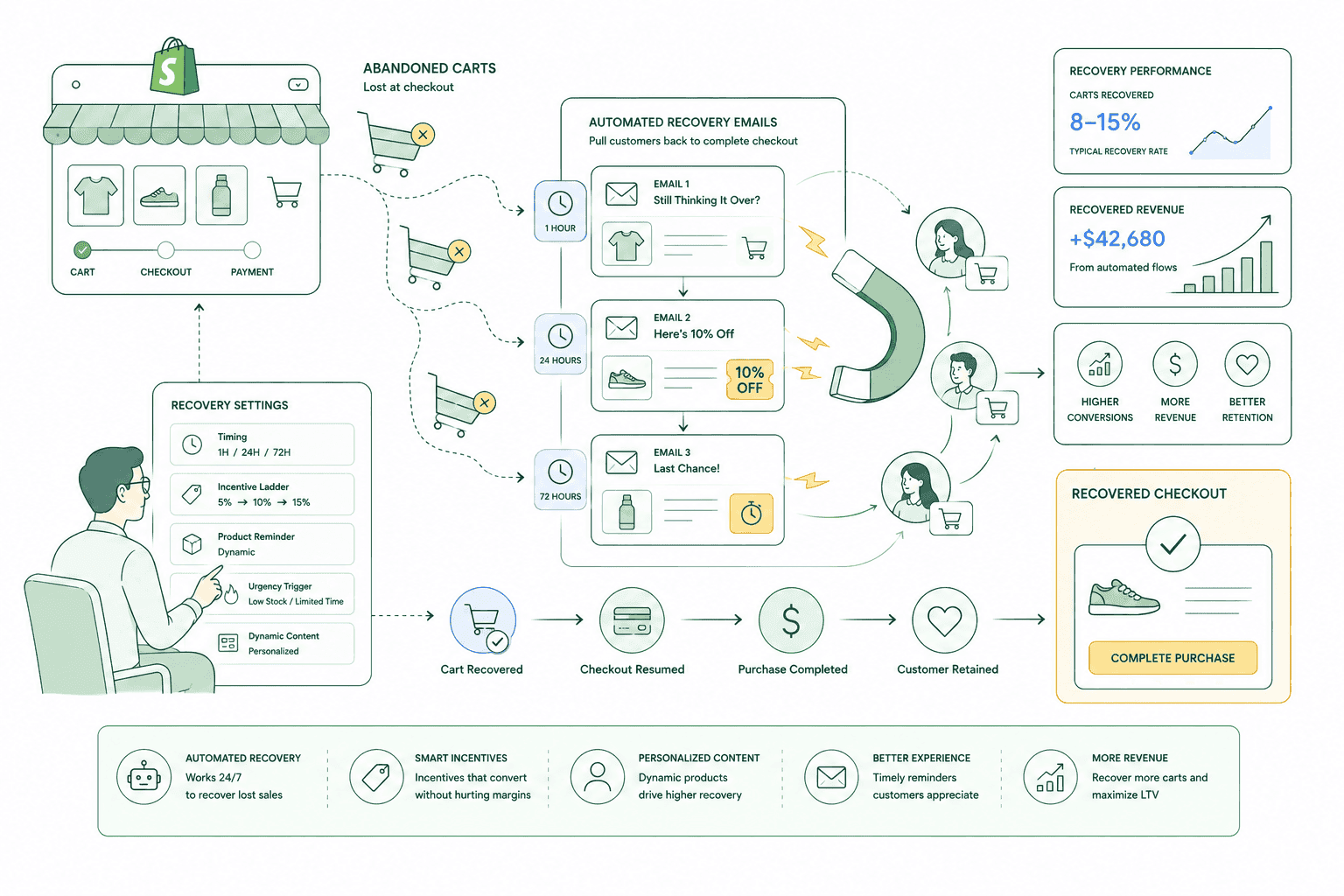
Why it matters
The highest-earning flow in ecommerce is usually the one left on defaults.
Shopify ships an abandoned checkout email, and most merchants assume that's the job done. It isn't. It's a single transactional-looking send, with no sequence, no segmentation, no branching and almost no control over content or timing — a safety net, not a recovery programme. A proper Klaviyo flow is a sequence of three or four sends spread across roughly 72 hours, each with a different job: remind, reassure, then make a decision easy. Get the trigger and the exclusions wrong and the same flow becomes the fastest way to annoy your best customers, so the build matters more than the copy.
Sound familiar?
The flow is switched on in Klaviyo, and it still looks like this.
Every one of these is common, and most of them are structural — a rebuild of the logic, not a rewrite of the copy.
- You're running Shopify's default abandoned checkout email and treating it as a complete recovery flow.
- Email one opens with ten percent off, and your regulars now abandon on purpose to trigger it.
- The flow fires on added-to-cart, so casual browsers get chased for three days straight.
- Customers who completed their order still receive two more reminders about that same cart.
- You assume more emails always recover more revenue, so the sequence has quietly grown to six.
- Your cart emails show a stock lifestyle image instead of the products the shopper actually left.
What's included
What an abandoned cart flow build includes
A sequence engineered around the actual behaviour of a hesitant buyer — not a template with your logo dropped in.
The right trigger, deliberately chosen
Checkout Started and Added to Cart are different events with different intent, and most stores conflate them. Checkout Started means a real email address and a real attempt to buy. Added to Cart fires on browsers who never got that far — useful, but it needs its own timing, its own copy and far tighter filters. We pick per store and document why.
Sequence timing that reflects hesitation
First send around an hour after abandonment, while the tab may still be open and the decision is live. Second at roughly 24 hours, when the reason for hesitating has surfaced. Third at 48 to 72 hours as the last realistic window. Beyond that, a cart email is just a newsletter about a product they didn't buy.
Dynamic cart and product blocks
The actual items, variants, sizes, images and prices pulled from the Klaviyo event, not a generic hero banner. Blocks handle the awkward cases too: single-item versus multi-item carts, long product titles, missing images, and items that sold out between the abandon and the send.
Exclusion and suppression logic
Anyone who completes the order exits immediately. Recent purchasers, active subscribers already in another high-priority flow, and suppressed or unengaged profiles are filtered out before the first send. Nothing costs more goodwill than chasing someone for a cart they already paid for.
SMS as a second channel, used sparingly
Where consent exists, one well-timed SMS between email one and two lifts recovery meaningfully. It also burns trust fast when overused. We set quiet hours, cap frequency, keep the message under a single segment, and honour AU and UK consent rules rather than treating a phone number at checkout as permission.
Offer strategy and testing
If a discount belongs in the flow at all, it belongs in the last email — not the first. We hold the incentive back, test subject lines, send delays and whether the offer earns its margin, then keep the version that wins on revenue rather than open rate.
How it runs
How the build actually runs.
Two to four weeks from kickoff to live, depending on how much of your tracking, consent and template foundation already works. Most of week one is diagnostic, not design.
- 01
Audit triggers and data
We confirm the Shopify–Klaviyo integration is passing clean events, check whether Checkout Started fires reliably, review your existing flow's exit conditions, and find the profiles currently being emailed who shouldn't be.
- 02
Map the sequence
Trigger, filters, delays, branches and exit conditions written out before a single email is designed. You approve the logic — including where the discount sits, if it sits anywhere — while it's still cheap to change.
- 03
Build, brand and QA
Templates built on your brand system, dynamic blocks wired to real cart data, then tested with live carts across desktop, mobile and dark mode. We deliberately test the ugly cases: one item, nine items, sold-out variants.
- 04
Launch and tune
Live with monitoring on placement and unsubscribe rate, not just revenue. After enough volume we test delays, subject lines and the offer itself, and report what changed against the flow's own baseline.
~70%
Carts abandoned
Widely cited industry benchmark
3–4
Emails per sequence
First send within ~1 hour
72 hrs
Recovery window
After that, intent is gone
2–4 wks
Build to live
Including QA and live cart tests
Straight answer
Who this is genuinely worth building for.
A good fit if…
- You have consistent checkout volume, so the flow has enough traffic to be worth optimising.
- Klaviyo is connected to Shopify and your product data and consent capture already work.
- You sell considered purchases where hesitation is normal and a reminder does real work.
- You're willing to hold discounts back and judge the flow on margin, not raw recovered revenue.
Probably not, if…
- You get a handful of checkouts a week — fix traffic and conversion before automating recovery.
- You want a discount in email one; that trains repeat customers to abandon and we won't build it.
- Your list was bought or imported without consent — that's a deliverability problem, not a flow problem.
- You expect a guaranteed recovery percentage. Nobody can promise that, and anyone who does is guessing.
Keep exploring
More on Shopify email marketing
Abandoned Cart Flow is one part of how we run Shopify email programmes. Here's the rest of the picture.
Shopify Email Marketing & Klaviyo
The complete service — every flow, campaigns, segmentation and deliverability.
View the serviceClosely relatedBrowse Abandonment
Catch intent before a cart exists, without emailing everyone who blinked at a product page.
Read the guideClosely relatedWelcome Series
The flow every new subscriber sees, and the one that decides whether they ever open you again.
Read the guideAll guides in this series
- Post-Purchase & ReplenishmentTurn a first order into a second one, timed to how the product is actually used.
- Winback & Re-engagementReach lapsed customers before they cost you deliverability by ignoring you.
- VIP & Loyalty FlowsIdentify the customers worth protecting, then treat them differently.
- Campaign Strategy & SendsA send calendar built on margin and inventory, not on what month it is.
- Segmentation & Predictive AIStop sending everything to everyone — segments that lift revenue and protect the list.
- Deliverability & Inbox PlacementAn email that lands in spam converts at zero, however good the copy is.
Beyond this service
Other things we do
Most stores need two or three of these working together. Book a call and we'll tell you which ones actually move your numbers.
- Shopify Theme DevelopmentCustom themes built from Figma to production Liquid on Online Store 2.0 — fast and merchant-editable.
- Shopify App DevelopmentCustom and public apps, Checkout UI Extensions and Shopify Functions built with React and Polaris.
- Shopify MigrationMove from WooCommerce, Magento or BigCommerce with a full 301 redirect map and zero downtime.
- Shopify SEOTechnical audits, Core Web Vitals, structured data and collection content built around buyer intent.
- Shopify Performance OptimizationFaster load times and green Core Web Vitals — theme refactors, image pipelines and app cleanup.
- Shopify A/B TestingHypothesis-led experiments on product pages and checkout, shipped as native theme code.
- Shopify Email Marketing & KlaviyoFlows, segmentation and campaigns — welcome, abandoned cart, winback and SMS, built and monitored.
- Shopify CRO & FunnelsValue-ladder, tripwire, quiz and post-purchase upsell funnels built to lift conversion and AOV.
- Shopify Maintenance & SupportRetainers covering uptime monitoring, security patching, bug fixes and proactive improvements.
Frequently asked questions
- It's better than nothing, and for a very small store it may be all you need. But it's one email with fixed timing, minimal design control, no branching and no segmentation — it can't tell a first-time visitor from a loyal customer, and it can't be extended into a sequence. A Klaviyo flow gives you multiple sends, real exclusion logic, dynamic cart contents and SMS in the same sequence. If you run both at once, turn Shopify's off, or people get duplicates.
Cart flow underperforming?
Book a 30-minute call. We'll look at your current flow's triggers, timing and exclusions, and tell you whether it needs a rebuild or just a rewrite.
Book a free call