Shopify Email Campaign Strategy & Sends
Flows run themselves once they're built. Campaigns are the part you decide every week — what to send, who should see it, and whether it's worth the unsubscribes. We build a send calendar around your margin, your inventory and your real seasonality, then send it to the segments that should receive it rather than to everyone on the list.
Book a Free Technical Call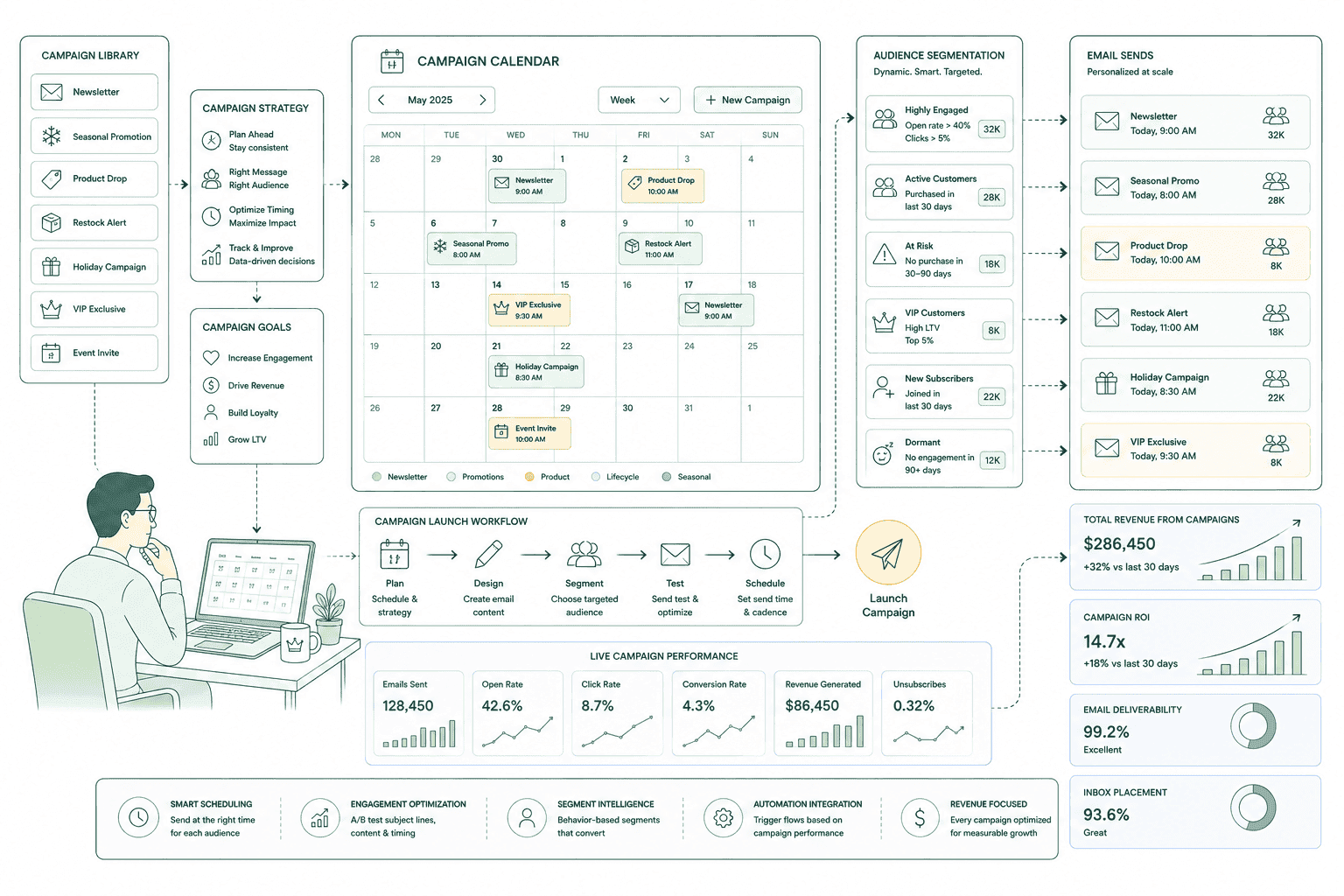
Why it matters
Most send calendars are built on habit. Yours should be built on margin.
The default calendar is a weekly newsletter on whatever day the last agency picked, sent to the whole list, usually carrying a discount because a discount is the easiest thing to write. It makes a number. It also trains your best customers to wait for the next code, discounts stock you were going to sell anyway, and pushes unsubscribe and complaint rates up every week. A calendar worth running starts somewhere else: which products carry margin, what stock needs to move, when your customers genuinely buy, and how much email a given segment can absorb before it stops opening. That is a commercial planning exercise that happens to be delivered by email — not a content schedule.
Sound familiar?
Campaign programmes tend to fail in the same few places.
Some of these are calendar problems. Some are segmentation problems wearing a calendar costume. The audit tells you which one you're looking at.
- You send every Tuesday because you always have, not because Tuesday earns anything extra.
- The whole list receives every campaign, and unsubscribes spike reliably after each one.
- Discount-led sends hit the monthly revenue number, then the margin quietly disappears.
- You can't say what share of email revenue comes from campaigns versus automated flows.
- BFCM planning starts in November, so creative gets rushed and offers get copied.
- You assume more sends always means more revenue, so frequency only ever goes up.
What's included
What campaign management covers
Planning, building, sending and reading the results — with the reasoning behind each send written down rather than held in someone's head.
A calendar built on commercial inputs
Sends are planned against margin by product, stock position, new-product timing and your genuine seasonal peaks — not against a template that says newsletter every Tuesday. Full-price stories get airtime, slow stock gets a specific push, and discounting becomes a decision rather than a reflex.
Segment-targeted sends
Every campaign gets its audience defined before the creative is written. A restock note goes to people who viewed or bought that product. A category launch goes to that category's buyers. Sending everything to everyone is the single fastest way to make a healthy list stop responding.
Campaign versus flow revenue split
We report campaigns and flows separately, because they behave differently and they get fixed differently. If campaigns carry an outsized share of email revenue, your flows are underbuilt. If flows carry almost everything, the list is being under-used. You'll see which problem you actually have.
Subject-line and creative testing
One variable at a time, on audiences large enough for the result to mean something. Subject line, sending name, hero treatment, offer framing, designed versus plain text. Smaller lists rarely produce a reliable winner on a single send, so we read tests across a run of sends instead of over-interpreting one.
BFCM and peak planning
Peak trading planned from September rather than the week before: offer architecture, send sequence, early-access segments, inventory-aware cut-offs and a contingency for a hero product selling out mid-campaign. Rushed peak creative is how a strong quarter turns into an ordinary one.
Frequency governance
Per-subscriber frequency caps, smart sending rules and a stated position on how much email each segment receives in a week. Engaged buyers tolerate more than lapsed ones. Applying one frequency to the whole list is how your least interested subscribers end up training spam filters against you.
How it runs
How campaign management actually runs.
Two to four weeks to move from your current send pattern to a signed-off quarter. After that it's a weekly operating rhythm rather than a project.
- 01
Read the send history
Ninety days of campaigns pulled apart: revenue per recipient, unsubscribe and complaint rate by segment, which sends leaned on discounts, and what happened to engagement in the weeks you sent twice.
- 02
Build the calendar
A quarter of planned sends mapped to margin, stock and season. Each one carries its audience, its purpose and its offer position, agreed before anyone writes a subject line. You sign it off.
- 03
Build and send
Copy, creative and segment build inside Klaviyo, with the test variable named up front. Sends run on a fixed weekly rhythm so the calendar survives busy weeks instead of quietly slipping.
- 04
Read and adjust
Monthly review of revenue per recipient, list health and the campaign-versus-flow split. Send types that underperform get cut rather than repeated, and frequency moves on evidence rather than ambition.
4–8
Sends per month
Capped, not maximised
90 days
Calendar horizon
Planned, not improvised
100%
Sends segmented
Audience set before creative
Sept
BFCM planning starts
Not the week before
Straight answer
Campaign management earns its place at some list sizes and not others.
A good fit if…
- You have a list of meaningful size and a catalogue with genuine reasons to email people.
- Your margin varies by product, so which items you promote materially changes profit.
- Peak trading matters to your year and currently gets planned far too late.
- Your flows are already built, so campaigns are the next real lever available.
Probably not, if…
- Your list is small and new — build the flows and grow the list first.
- You have no flows running. Campaigns cannot compensate for missing automation.
- You want daily sends and a discount on every one. We'd be the wrong agency.
- Deliverability is already broken. Fix inbox placement before adding send volume.
Keep exploring
More on Shopify email marketing
Campaign Strategy & Sends is one part of how we run Shopify email programmes. Here's the rest of the picture.
Shopify Email Marketing & Klaviyo
The complete service — every flow, campaigns, segmentation and deliverability.
View the serviceClosely relatedSegmentation & Predictive AI
The segments that decide who each campaign should actually reach.
Read the guideClosely relatedDeliverability & Inbox Placement
Send frequency and inbox placement are the same conversation. Here's the technical half.
Read the guideAll guides in this series
- Abandoned Cart FlowThe highest-earning flow in ecommerce, and the one most stores leave on defaults.
- Welcome SeriesFirst impression and first purchase — the flow every new subscriber sees.
- Browse AbandonmentCatch intent before a cart exists, without emailing everyone who blinked.
- Post-Purchase & ReplenishmentTurn a first order into a second one, timed to how the product is actually used.
- Winback & Re-engagementReach lapsed customers before they cost you deliverability by ignoring you.
- VIP & Loyalty FlowsIdentify the customers worth protecting, then treat them differently.
Beyond this service
Other things we do
Most stores need two or three of these working together. Book a call and we'll tell you which ones actually move your numbers.
- Shopify Theme DevelopmentCustom themes built from Figma to production Liquid on Online Store 2.0 — fast and merchant-editable.
- Shopify App DevelopmentCustom and public apps, Checkout UI Extensions and Shopify Functions built with React and Polaris.
- Shopify MigrationMove from WooCommerce, Magento or BigCommerce with a full 301 redirect map and zero downtime.
- Shopify SEOTechnical audits, Core Web Vitals, structured data and collection content built around buyer intent.
- Shopify Performance OptimizationFaster load times and green Core Web Vitals — theme refactors, image pipelines and app cleanup.
- Shopify A/B TestingHypothesis-led experiments on product pages and checkout, shipped as native theme code.
- Shopify Email Marketing & KlaviyoFlows, segmentation and campaigns — welcome, abandoned cart, winback and SMS, built and monitored.
- Shopify CRO & FunnelsValue-ladder, tripwire, quiz and post-purchase upsell funnels built to lift conversion and AOV.
- Shopify Maintenance & SupportRetainers covering uptime monitoring, security patching, bug fixes and proactive improvements.
Frequently asked questions
- There's no single correct number, and anyone who gives you one without looking at your data is guessing. It depends on catalogue size, purchase cycle, how recently people subscribed and how engaged each segment is. The honest framing is that revenue per send falls as frequency rises, while unsubscribe and complaint rates climb. Somewhere on that curve is the point where an extra send costs more in list health than it returns in orders. We find yours by moving frequency gradually and watching both numbers, not by copying another brand's schedule.
Sending on autopilot?
Book a 30-minute call. We'll look at your last 90 days of campaigns and tell you whether the problem is the calendar, the segments or the frequency.
Book a free call