Klaviyo Post-Purchase & Replenishment Flows
Most stores stop emailing the moment money changes hands. We build the sequence that runs between the order confirmation and the second purchase — onboarding, cross-sell, review requests and a reorder nudge timed to how the product is actually used.
Book a Free Technical Call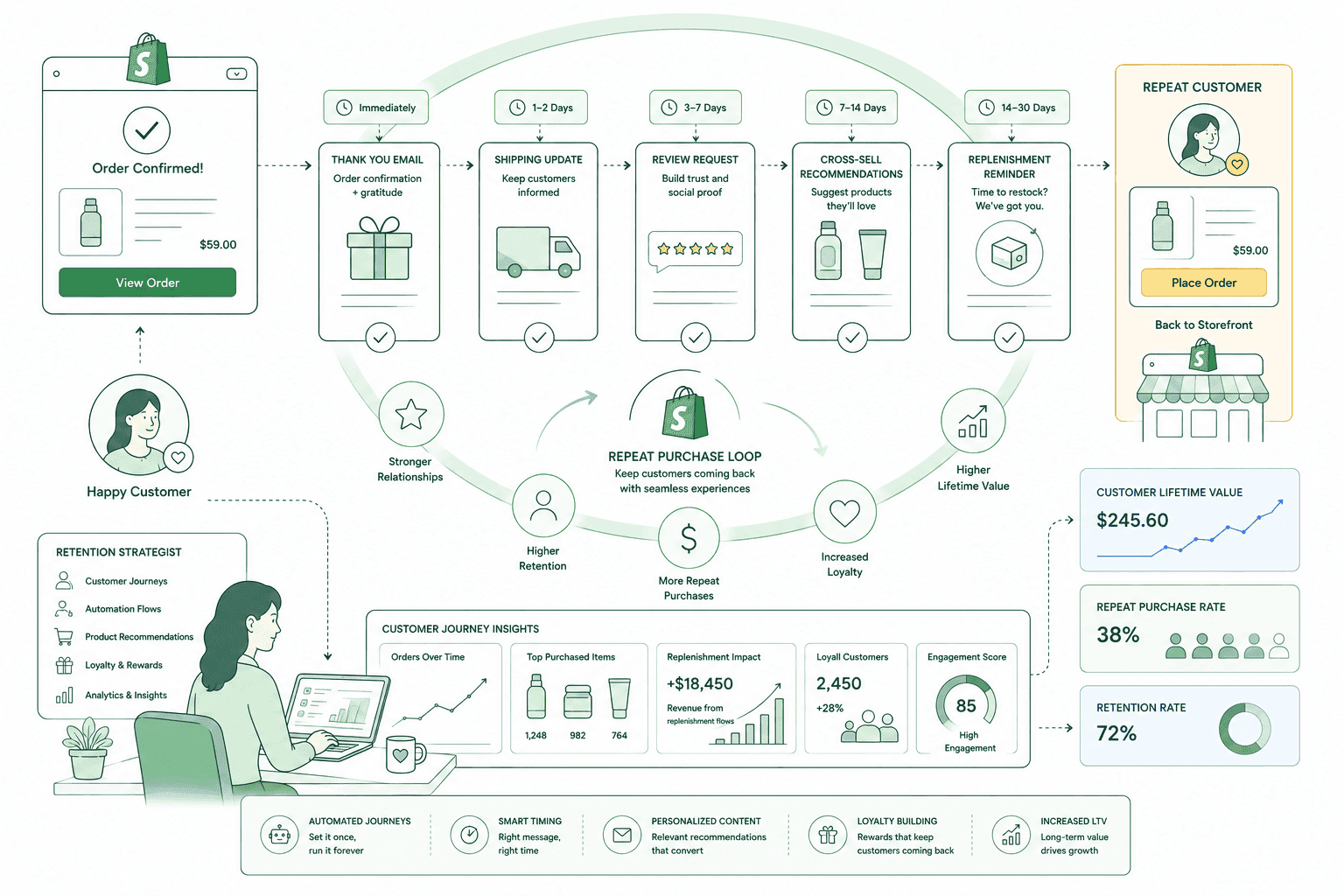
Why it matters
Post-purchase is the cheapest revenue in the account, and the least-built part of it.
You have already paid to acquire this customer. You have their address, their order history, their consent and, briefly, their full attention — post-purchase emails routinely see the highest open rates in the account because people genuinely want to know where their parcel is. Spending that attention on a bare tracking link is a waste. The stores that grow repeat rate treat the window between delivery and the next order as a designed sequence: teach the product, ask for the review at the right moment, suggest the thing that genuinely pairs with what was bought, and prompt the reorder when the first one is nearly gone. None of that requires new traffic, new creative budget or a new channel.
Sound familiar?
The order confirmation is the last email most stores ever send.
If several of these describe your account, the gap between first and second order is being left entirely to chance.
- Your order confirmation earns the best open rate in the account and contains nothing but a tracking number.
- You send a replenishment reminder thirty days after every order, regardless of what was actually bought.
- Review requests go out when the parcel is dispatched, so people reply before they have opened it.
- Your support inbox fills with 'how do I use this' questions the product page already answers badly.
- You treat post-purchase email as transactional admin, so nobody on the marketing side has ever touched it.
- Your subscription option sits on the product page and one-off buyers never hear about it again.
What's included
What a post-purchase build includes
Six connected flows, triggered on real fulfilment events, with timing derived from your order data rather than a template.
Delivery-triggered onboarding
The sequence starts when the parcel actually arrives, not when the order is placed. That single change makes every message land in context: unboxing, first-use guidance and care instructions reach someone holding the product, rather than someone still waiting three days out from a courier scan.
Replenishment on real cycles
A blanket 30-day reminder is wrong for almost every product you sell. We pull reorder intervals from your own order history per product or category, then set the nudge to land shortly before the average customer runs out — early enough to prevent a competitor purchase, late enough not to feel pushy.
Cross-sell from the actual order
Recommendations conditioned on what was purchased, not on your bestsellers list. Someone who bought a starter kit gets the refill and the next step up; someone who bought the refill does not get sold the kit they already own. Conditional splits do the work Klaviyo's generic product block cannot.
Review and UGC requests
Timed after delivery plus enough days to form an opinion, not the moment the label prints. We also gate by product: a consumable needs a fortnight of use before the review is worth reading, an accessory needs a few days. Requests route into your review platform with the order pre-matched.
How-to content that prevents returns
The three questions your support team answers every day, sent before the customer has to ask. Sizing adjustments, application technique, first-wash instructions, common setup mistakes. This is the least glamorous flow in the build and usually the one that pays for itself fastest in avoided returns and tickets.
Subscription conversion prompts
If you sell a subscription, the best moment to pitch it is the second manual reorder — the customer has proven the cycle exists and has already repeated the purchase friction once. We only build this where a subscription genuinely exists and the maths works for your margin.
How it runs
How a post-purchase build actually runs.
Two to four weeks, depending on how many product families need their own replenishment timing and how clean your fulfilment data is.
- 01
Map consumption cycles
We pull order data and work out the real repurchase interval per product or category. A 30ml serum and a 2kg protein tub are not on the same clock, and averaging them produces a reminder that suits neither.
- 02
Design the sequence
Delivery onboarding, cross-sell logic tied to the actual order, review timing, the replenishment nudge and any subscription prompt. Every message gets a defined job. Anything that exists only to fill a gap in the schedule gets cut.
- 03
Build and wire triggers
Flows built against fulfilment and delivery events rather than order-created, with conditional splits per product family, suppression for anyone who has already reordered, and clean handoff into your review platform.
- 04
Watch, then adjust
Six to eight weeks of data tells you whether the timing assumption held. We move the replenishment delay to match observed reorder behaviour instead of defending the first estimate, and prune messages nobody engages with.
6
Touchpoints mapped
Confirmation through reorder
Per SKU
Replenishment timing
Real consumption cycles
0
Discounts required
Timing does the work
2–4 wks
Build to live
Creative and logic
Straight answer
Post-purchase pays off for some catalogues and does nothing for others.
A good fit if…
- You sell consumables, refills or anything with a repeat cycle visible in your own order data.
- You have enough monthly orders that timing decisions rest on real numbers rather than a hunch.
- Your product needs explaining, and confused customers currently turn into refunds or support tickets.
- Your welcome series and cart flow already work, and you want the next-cheapest revenue available.
Probably not, if…
- You sell one-off, high-consideration items people buy once a decade. There is no second cycle to catch.
- Your fulfilment data never reaches Klaviyo, so every trigger would fire on the wrong event.
- You want a discount code in every post-purchase message, which simply trains customers to wait.
- Your abandoned cart and welcome flows are still on Klaviyo defaults. Those earn more, sooner.
Keep exploring
More on Shopify email marketing
Post-Purchase & Replenishment is one part of how we run Shopify email programmes. Here's the rest of the picture.
Shopify Email Marketing & Klaviyo
The complete service — every flow, campaigns, segmentation and deliverability.
View the serviceClosely relatedVIP & Loyalty Flows
Once repeat buyers exist, this is how you identify the ones worth protecting.
Read the guideClosely relatedSegmentation & Predictive AI
Replenishment timing depends on segments that reflect real behaviour, not guesses.
Read the guideAll guides in this series
- Abandoned Cart FlowThe highest-earning flow in ecommerce, and the one most stores leave on defaults.
- Welcome SeriesFirst impression and first purchase — the flow every new subscriber sees.
- Browse AbandonmentCatch intent before a cart exists, without emailing everyone who blinked.
- Winback & Re-engagementReach lapsed customers before they cost you deliverability by ignoring you.
- Campaign Strategy & SendsA send calendar built on margin and inventory, not on what month it is.
- Deliverability & Inbox PlacementAn email that lands in spam converts at zero, however good the copy is.
Beyond this service
Other things we do
Most stores need two or three of these working together. Book a call and we'll tell you which ones actually move your numbers.
- Shopify Theme DevelopmentCustom themes built from Figma to production Liquid on Online Store 2.0 — fast and merchant-editable.
- Shopify App DevelopmentCustom and public apps, Checkout UI Extensions and Shopify Functions built with React and Polaris.
- Shopify MigrationMove from WooCommerce, Magento or BigCommerce with a full 301 redirect map and zero downtime.
- Shopify SEOTechnical audits, Core Web Vitals, structured data and collection content built around buyer intent.
- Shopify Performance OptimizationFaster load times and green Core Web Vitals — theme refactors, image pipelines and app cleanup.
- Shopify A/B TestingHypothesis-led experiments on product pages and checkout, shipped as native theme code.
- Shopify Email Marketing & KlaviyoFlows, segmentation and campaigns — welcome, abandoned cart, winback and SMS, built and monitored.
- Shopify CRO & FunnelsValue-ladder, tripwire, quiz and post-purchase upsell funnels built to lift conversion and AOV.
- Shopify Maintenance & SupportRetainers covering uptime monitoring, security patching, bug fixes and proactive improvements.
Frequently asked questions
- From your order history, not a template. We look at customers who have ordered the same product more than once and measure the actual gap between orders, then set the reminder to land a little before the median. Products with genuinely different consumption rates get their own timing. Where there is not enough repeat data yet — a new SKU, say — we start from the pack size and stated usage, flag it as an estimate, and correct it once real reorders come in.
Leaving money between the first and second order?
Book a 30-minute call. We'll look at your repeat rate and reorder intervals and tell you whether a post-purchase build is worth it — or whether your cart and welcome flows should come first.
Book a free call