Klaviyo Winback & Re-engagement Flows
Winback is two jobs in one flow: recover the customers who genuinely drifted, and remove the ones who are never coming back before they wreck your inbox placement. We build both halves, and we are honest about which contacts belong in which group.
Book a Free Technical Call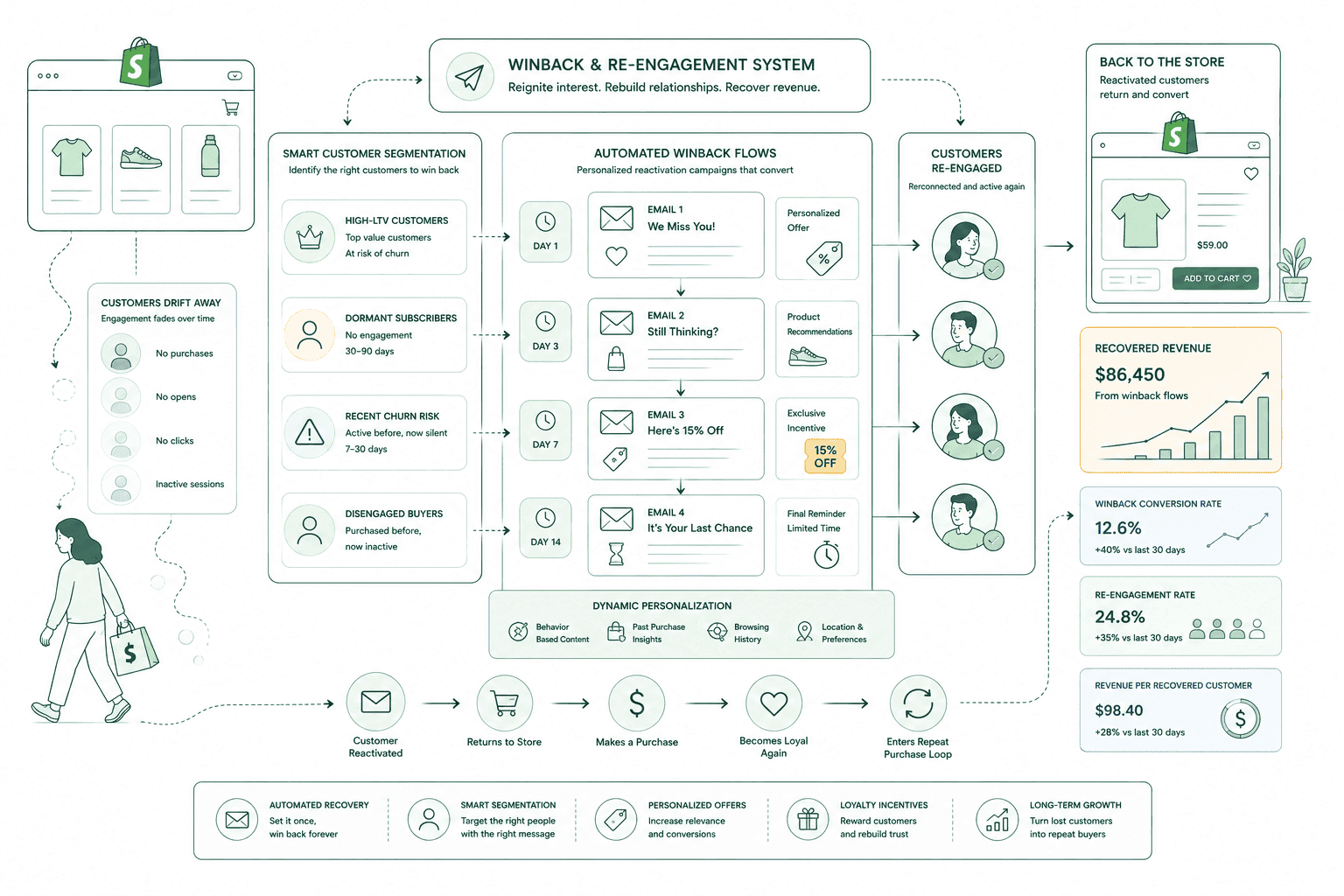
Why it matters
A dead subscriber is not neutral. They actively cost you the inbox.
Mailbox providers judge your sender reputation on how recipients behave, and a large block of contacts who never open anything drags every send you make towards the promotions tab and then the spam folder. That means the customers you can still win back stop seeing you, because you kept emailing the ones you cannot. Winback done properly starts with an honest definition of lapsed — based on how often your customers actually buy, not a borrowed 90-day rule — then makes a small number of genuine attempts, and finally suppresses everyone who did not respond. The suppression step is the one clients resist and the one that does the most good.
Sound familiar?
Lapsed does not mean ninety days. It means overdue for your product.
Most winback flows misfire because the definition underneath them was copied from a blog post about a different business.
- You call a customer lapsed at ninety days, but your average reorder cycle is closer to seven months.
- Thousands of subscribers have not opened anything in two years and still receive every campaign you send.
- Your open rates fell off a cliff and nobody can explain why the content suddenly stopped working.
- You believe a bigger list is a better list, so nothing has ever been suppressed or sunset.
- Every winback email opens with a discount, and your regulars have learned it pays to go quiet.
- You delete unengaged contacts outright, so returning customers arrive with no history attached.
What's included
What a winback build includes
A lapsed definition grounded in your data, a short escalation that respects margin, and a sunset policy that finally gets enforced.
Lapsed defined by your cycle
We calculate the real gap between orders for your repeat customers, then set lapsed at the point where a customer is meaningfully overdue rather than merely between purchases. For a coffee subscription that might be six weeks. For outerwear it might be fourteen months. Ninety days is somebody else's number.
Value-tiered segments
A lapsed customer who ordered eleven times deserves a different message and a different level of effort than someone who bought once on a launch discount. Segments split by order count, margin contribution and category, so the flow spends its incentive budget where there is something worth recovering.
Escalation that holds back
The first message is not an offer. It is a reason to look again — new products, a reformulation, a problem you have fixed. Discounting is the last resort, applied only to segments where the maths supports it, because a predictable winback code teaches your best customers to lapse on purpose.
Re-permission campaigns
For contacts who are unengaged but not clearly gone, a plain, honest email asking whether they still want to hear from you. It converts a small share into active subscribers and gives everyone else a clean exit. Run correctly it also gives you a defensible consent record.
Sunset and suppress, never delete
Contacts who fail the sequence get suppressed, not deleted. Suppression preserves consent history, unsubscribe status and order data, so they can be recognised if they return and are never accidentally re-imported. Deleting a profile throws that away and creates a compliance gap.
Deliverability monitoring
Before, during and after. We baseline your open rates, complaint rate and inbox placement by provider, then track what happens as the unengaged block leaves the sending pool. If reputation does not recover, the problem is authentication or content, and we say so rather than sending more.
How it runs
How a winback build actually runs.
Two to four weeks for the build. The sunset policy is the quickest part to implement and by far the hardest to get agreement on.
- 01
Define lapsed properly
We measure the distribution of gaps between orders in your own data and pick a threshold where a customer is genuinely overdue. Different categories often get different thresholds, because a refill and a coat behave nothing alike.
- 02
Audit the dead weight
How many contacts have not opened in six, twelve, twenty-four months, and what share of every send they represent. This is the number that explains your engagement rates, and it is usually larger than clients expect.
- 03
Build the escalation
Three or four messages: a reason to return, a reminder of what has changed, then an incentive only for segments that justify one. Value tiers get different copy and different offers, and some tiers get no offer at all.
- 04
Sunset, suppress, monitor
Anyone who does not respond exits the sending pool through suppression. We then watch complaint rate, open rate and provider-level placement for six to eight weeks to confirm reputation is actually recovering.
3–4
Emails per sequence
Escalating, not repeating
2×
Purchase cycle to lapse
Yours, not a generic 90 days
180d
Typical sunset point
Protects sender reputation
2–4 wks
Build to live
Including suppression rules
Straight answer
Winback recovers a fraction of churn. It is not an acquisition strategy.
A good fit if…
- You have a measurable purchase cycle and a meaningful population of customers who are genuinely overdue.
- Your engagement rates have slipped and you suspect the list rather than the copy.
- You are willing to suppress a large share of contacts to protect inbox placement for the rest.
- You have a real reason to return: new products, a reformulation, or a service problem you have fixed.
Probably not, if…
- You launched six months ago. Nobody is lapsed yet — they are simply between orders.
- You expect winback to fix an acquisition shortfall. It recovers a minority of churned buyers, no more.
- You will not suppress anyone, which makes the deliverability half of this work impossible to deliver.
- You had a quality or fulfilment failure you have not resolved. Emailing those customers makes it worse.
Keep exploring
More on Shopify email marketing
Winback & Re-engagement is one part of how we run Shopify email programmes. Here's the rest of the picture.
Shopify Email Marketing & Klaviyo
The complete service — every flow, campaigns, segmentation and deliverability.
View the serviceClosely relatedDeliverability & Inbox Placement
Suppression is one lever. Authentication, warm-up and content are the rest of the picture.
Read the guideClosely relatedSegmentation & Predictive AI
Winback tiers are only as good as the segments and engagement definitions beneath them.
Read the guideAll guides in this series
- Abandoned Cart FlowThe highest-earning flow in ecommerce, and the one most stores leave on defaults.
- Welcome SeriesFirst impression and first purchase — the flow every new subscriber sees.
- Browse AbandonmentCatch intent before a cart exists, without emailing everyone who blinked.
- Post-Purchase & ReplenishmentTurn a first order into a second one, timed to how the product is actually used.
- VIP & Loyalty FlowsIdentify the customers worth protecting, then treat them differently.
- Campaign Strategy & SendsA send calendar built on margin and inventory, not on what month it is.
Beyond this service
Other things we do
Most stores need two or three of these working together. Book a call and we'll tell you which ones actually move your numbers.
- Shopify Theme DevelopmentCustom themes built from Figma to production Liquid on Online Store 2.0 — fast and merchant-editable.
- Shopify App DevelopmentCustom and public apps, Checkout UI Extensions and Shopify Functions built with React and Polaris.
- Shopify MigrationMove from WooCommerce, Magento or BigCommerce with a full 301 redirect map and zero downtime.
- Shopify SEOTechnical audits, Core Web Vitals, structured data and collection content built around buyer intent.
- Shopify Performance OptimizationFaster load times and green Core Web Vitals — theme refactors, image pipelines and app cleanup.
- Shopify A/B TestingHypothesis-led experiments on product pages and checkout, shipped as native theme code.
- Shopify Email Marketing & KlaviyoFlows, segmentation and campaigns — welcome, abandoned cart, winback and SMS, built and monitored.
- Shopify CRO & FunnelsValue-ladder, tripwire, quiz and post-purchase upsell funnels built to lift conversion and AOV.
- Shopify Maintenance & SupportRetainers covering uptime monitoring, security patching, bug fixes and proactive improvements.
Frequently asked questions
- We look at the actual distribution of intervals between orders for your repeat customers, then set the threshold at a point where someone is clearly overdue rather than simply mid-cycle — often somewhere past the 75th percentile of that distribution. Categories with very different consumption rates get separate thresholds. The one thing we will not do is apply a generic ninety-day rule, because for a slow-cycle catalogue it emails people who are behaving perfectly normally.
Emailing people who stopped listening?
Book a 30-minute call. We'll look at your engagement decay and purchase cycle and tell you how much of your list is worth chasing — and how much is costing you the inbox.
Book a free call