Klaviyo Segmentation & Predictive Analytics
Segmentation is the difference between a list that grows more valuable each year and one that slowly stops opening. We build RFM segments off your real order data, wire Shopify catalogue and tag data into Klaviyo properly, and use the predictive metrics where they hold up — while being straight with you about where they don't.
Book a Free Technical Call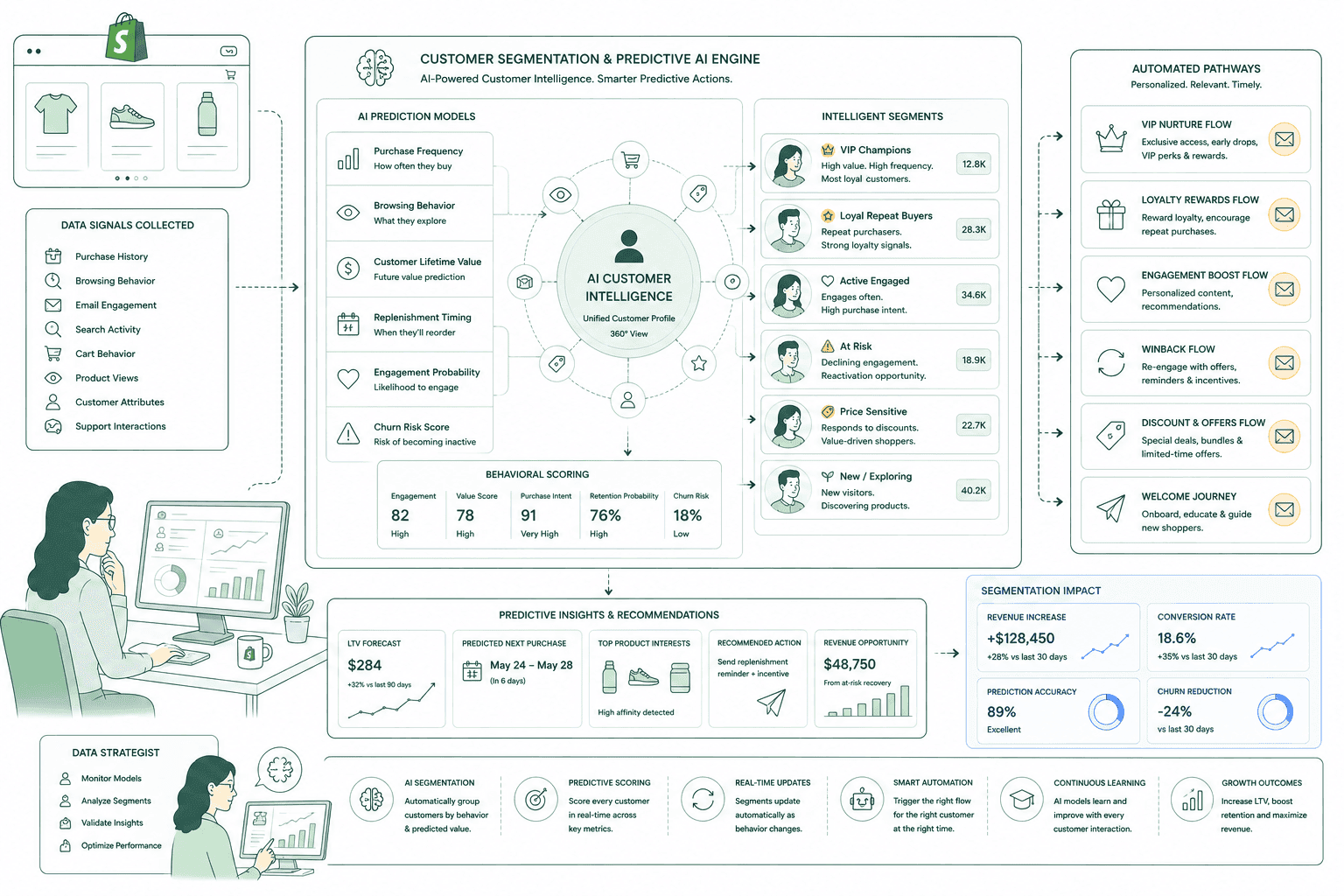
Why it matters
Your list is not one audience. Treating it as one is what breaks it.
A subscriber who bought three times this year and a subscriber who signed up eighteen months ago and has never opened anything are not the same person, and sending them the same email serves neither. Segmentation does two jobs at once. It lifts revenue, because relevant email converts better than general email. It also protects the programme, because mailbox providers judge you on how the people you email behave — and the fastest way to damage inbox placement is to keep sending to people who ignore you. Good segmentation is mostly unglamorous: clean data flowing in from Shopify, definitions everyone agrees on, and the discipline to exclude people rather than include them.
Sound familiar?
Segmentation problems show up as list decay before they show up as revenue.
By the time open rates have visibly fallen, the damage has usually been accumulating for months. These are the earlier symptoms.
- Your segments are 'all subscribers' and 'purchasers', and nothing else has ever been built.
- Customers get promoted a product they bought from you four days earlier.
- Open rates fall every quarter while list size grows, and nobody can explain why.
- You're emailing subscribers who haven't opened anything in over a year.
- You think predicted lifetime value is meaningful on an account with a hundred orders.
- Shopify tags and product types exist in your store but not inside Klaviyo.
What's included
What the segmentation build covers
A segment architecture you can actually explain — each one with a stated definition, a purpose and a rule for who it excludes.
RFM segmentation
Recency, frequency and monetary value scored against your own order history rather than a generic template. That produces the segments worth acting on: new buyers, repeat buyers, high-value customers, at-risk regulars and genuinely lapsed. Thresholds are set from your purchase cycle, because a coffee subscription and a furniture brand look nothing alike.
Predictive analytics, used honestly
Klaviyo's predicted lifetime value, churn risk and expected date of next order are genuinely useful once an account has enough order history behind it. Below that threshold the numbers appear anyway and mean very little. We check whether your data supports them before building anything that depends on them.
Engaged versus unengaged logic
Engaged-only sending as the default, with the window tuned to your purchase cycle instead of copied from a blog post. It costs some reach on paper. It protects inbox placement for everyone who does want your email, which is worth far more than the reach you lose.
Behavioural over demographic data
What people browsed, added, bought, returned and how often beats what they told you at signup. Demographic fields age badly and get filled in carelessly. Behavioural segments update themselves and describe intent, which is the thing an email is actually trying to meet.
Shopify catalogue and tag data
Product types, collections, vendors, variants, customer tags and order attributes synced into Klaviyo as usable properties. Without this, segments can only reference order value and dates — with it you can target the people who buy one category, one size or one price bracket.
Suppression architecture
Explicit rules for who never receives a given send: recent purchasers of the item, current subscription customers, wholesale accounts, refund and dispute histories, and anyone in a sunset segment. Suppression is where segmentation earns most of its keep, and it's the part most accounts have never set up.
How it runs
How the segmentation build runs.
Two to four weeks, depending on how much Shopify data needs remapping into Klaviyo before any segment can be trusted.
- 01
Audit the data
What's actually flowing from Shopify into Klaviyo, what's missing, and how much order history exists. This determines whether predictive metrics are usable for you or purely decorative right now.
- 02
Score the customers
RFM thresholds set against your real purchase cycle, then validated by checking whether the resulting segments behave differently. A segmentation model that produces identical behaviour across tiers isn't a model.
- 03
Build and exclude
Segments built in Klaviyo with definitions documented in plain language, plus the suppression rules that keep recent buyers, subscribers and sunset candidates out of the wrong sends.
- 04
Sunset and monitor
A standing sunset policy so unengaged profiles leave the sending pool on a schedule rather than by occasional cleanup, with segment sizes and engagement reviewed monthly.
RFM
Scoring model
Built on your order data
90 days
Engaged window
Protects inbox placement
6+
Core segments built
Behavioural, not demographic
2–4 wks
Build to live
Definitions documented
Straight answer
Segmentation needs data underneath it. Some accounts don't have it yet.
A good fit if…
- You have enough order history for repeat-purchase patterns to be visible and stable.
- Your catalogue spans categories or price points where relevance genuinely changes response.
- Engagement is drifting downward and you'd rather fix the cause than the subject lines.
- You sell replenishable or repeat-purchase products where timing is a real lever.
Probably not, if…
- You launched recently and have very few orders — predictive metrics will mislead you.
- You sell one product with no repeat cycle; segmentation has little left to separate.
- You want to keep emailing everyone and just add segments on top. That defeats it.
- Your Shopify data is a mess and you don't want it cleaned up first.
Keep exploring
More on Shopify email marketing
Segmentation & Predictive AI is one part of how we run Shopify email programmes. Here's the rest of the picture.
Shopify Email Marketing & Klaviyo
The complete service — every flow, campaigns, segmentation and deliverability.
View the serviceClosely relatedCampaign Strategy & Sends
Segments only matter if the send calendar actually uses them. Here's that half.
Read the guideClosely relatedDeliverability & Inbox Placement
Why engaged-only sending is a deliverability decision before it's a revenue one.
Read the guideAll guides in this series
- Abandoned Cart FlowThe highest-earning flow in ecommerce, and the one most stores leave on defaults.
- Welcome SeriesFirst impression and first purchase — the flow every new subscriber sees.
- Browse AbandonmentCatch intent before a cart exists, without emailing everyone who blinked.
- Post-Purchase & ReplenishmentTurn a first order into a second one, timed to how the product is actually used.
- Winback & Re-engagementReach lapsed customers before they cost you deliverability by ignoring you.
- VIP & Loyalty FlowsIdentify the customers worth protecting, then treat them differently.
Beyond this service
Other things we do
Most stores need two or three of these working together. Book a call and we'll tell you which ones actually move your numbers.
- Shopify Theme DevelopmentCustom themes built from Figma to production Liquid on Online Store 2.0 — fast and merchant-editable.
- Shopify App DevelopmentCustom and public apps, Checkout UI Extensions and Shopify Functions built with React and Polaris.
- Shopify MigrationMove from WooCommerce, Magento or BigCommerce with a full 301 redirect map and zero downtime.
- Shopify SEOTechnical audits, Core Web Vitals, structured data and collection content built around buyer intent.
- Shopify Performance OptimizationFaster load times and green Core Web Vitals — theme refactors, image pipelines and app cleanup.
- Shopify A/B TestingHypothesis-led experiments on product pages and checkout, shipped as native theme code.
- Shopify Email Marketing & KlaviyoFlows, segmentation and campaigns — welcome, abandoned cart, winback and SMS, built and monitored.
- Shopify CRO & FunnelsValue-ladder, tripwire, quiz and post-purchase upsell funnels built to lift conversion and AOV.
- Shopify Maintenance & SupportRetainers covering uptime monitoring, security patching, bug fixes and proactive improvements.
Frequently asked questions
- They're useful with caveats, and the caveats matter. Predicted lifetime value, churn risk and expected date of next order are modelled from your order history, so they need enough of it — a reasonable volume of orders and a meaningful number of repeat customers — before the output is worth acting on. Klaviyo itself gates some of these metrics behind data thresholds for exactly this reason. On a young store the numbers will still render, and they'll be noise. We check the underlying data before building any flow or segment that depends on a prediction, and if it isn't there yet we'll use straightforward RFM logic instead and revisit later.
Emailing everyone, every time?
Book a 30-minute call. We'll look at your Klaviyo data, tell you whether the predictive metrics are usable yet, and show you what's missing from the Shopify sync.
Book a free call