Klaviyo Browse Abandonment Flow
Browse abandonment catches intent before a cart exists — someone looked closely at a product and left. It's a genuinely useful flow and a genuinely minor one: it earns a fraction of what abandoned cart does, because browsing is weak intent. We build it with onsite tracking verified first, filters tight enough to matter, and suppression rules so nobody receives three emails about the same product.
Book a Free Technical Call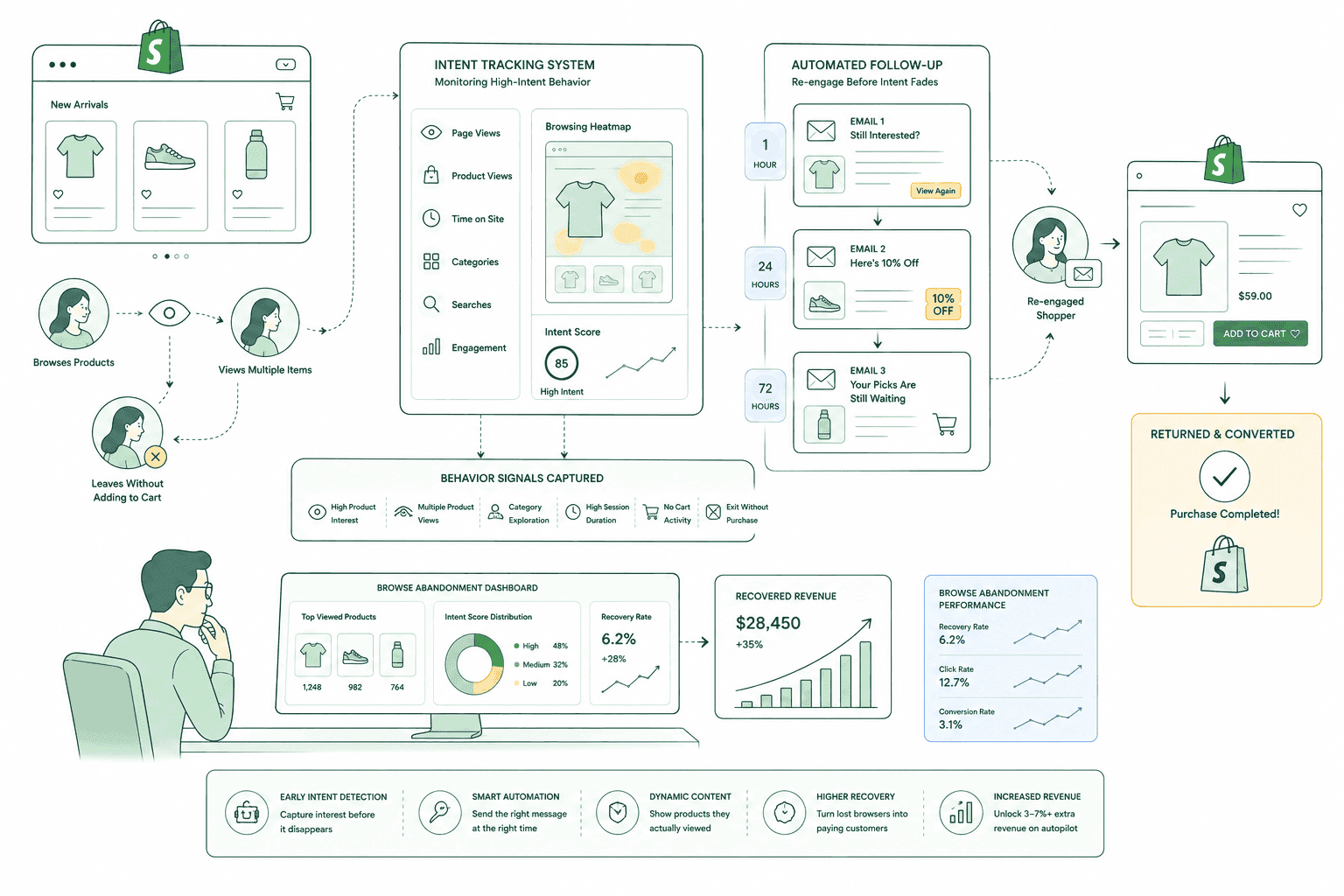
Why it matters
Browsing is weak intent, and the flow has to be built like it knows that.
Abandoned cart works because someone made a decision and stopped short of paying for it. Browse abandonment fires on a much weaker signal — a product page view from a known profile — which means the same aggressive sequence that works for carts produces irritation here. It also sits directly upstream of the cart and checkout flows, so without suppression a single shopper can trigger browse, cart and checkout emails within an hour of each other. Our honest position is that this is a supporting flow. Build abandoned cart and the welcome series first, get them right, then add browse abandonment as an incremental gain rather than expecting it to change your month.
Sound familiar?
The flow is either not firing at all, or firing at everyone.
Browse abandonment fails in two directions, and both are common. Here's what each one looks like in practice.
- Your browse flow is live in Klaviyo but sends almost nothing, because onsite tracking was never installed.
- A shopper who added to cart still gets a browse email about the product now sitting in it.
- You expect browse abandonment to earn like abandoned cart, and it never will.
- Regular visitors receive a browse email nearly every day because there's no frequency cap.
- The flow triggers on a single page view, so accidental clicks and price checks count as intent.
- Your emails reference exact products in a range that changes weekly, so half the links are dead.
What's included
What a browse abandonment build includes
A narrow, well-filtered flow that adds revenue without adding noise to an already-emailed audience.
Onsite tracking installed and verified
The flow depends on Klaviyo's onsite JavaScript firing Viewed Product with correct data on every product template. We install or repair it, check it against custom PDP templates, headless routes and app-injected pages, then verify real events land before building anything on top.
Qualifying filters that raise the bar
A single page view isn't intent. We qualify on repeat views, dwell where it's measurable, or multiple views within one session, and exclude cheap or clearance products where a reminder is never worth the send. Fewer, better-targeted emails beat broad coverage on this flow.
Suppression against cart and checkout flows
If a browser then adds to cart or starts checkout, they belong in the higher-intent flow and must exit this one immediately. We set priority order across all three flows, so nobody receives a browse email, a cart email and an SMS about the same product in the same afternoon.
Category versus product-level triggering
For narrow catalogues, referencing the exact product viewed works well. For broad or highly variable ranges, triggering at category level and showing a curated selection performs better and feels less like surveillance. We pick per catalogue rather than defaulting to one pattern.
Frequency caps and flow-level throttling
Smart Sending, per-profile caps and a minimum gap between browse emails, so a shopper who visits daily doesn't get a daily email. Caps are set across the whole programme, not just this flow — campaign sends count against the same attention budget.
Copy that doesn't sound like tracking
Nobody enjoys 'we noticed you were looking at this'. The email works better as a genuinely useful nudge: the product, similar options, the answers to the obvious hesitations. One or two emails, no discount, no urgency invented from nothing.
How it runs
How the build actually runs.
Two to four weeks, and the first week is mostly tracking work. If Viewed Product isn't firing cleanly, nothing built on top of it can be trusted.
- 01
Verify onsite tracking
We check the Klaviyo snippet across every product template, including custom PDPs and any app-rendered pages, then watch real Viewed Product events land with correct product data before designing a single email.
- 02
Set filters and priority
Qualifying rules written to raise the intent bar, plus explicit priority against the cart and checkout flows. You approve exactly who qualifies and who gets excluded, so the suppression rules are a decision rather than an accident.
- 03
Build one or two emails
Short sequence, dynamic product or category blocks, and handling for items that sell out or get removed between the view and the send. Tested with real browsing sessions on desktop and mobile, dark mode included.
- 04
Launch and cap
Live with frequency caps applied programme-wide, then monitored on unsubscribe and placement as closely as on revenue. If the numbers don't justify the noise, we'll tell you to switch it off.
1–2
Emails per sequence
Weak intent, light touch
24 hrs
Trigger window
Beyond that it is noise
3
Flows suppressed against
Cart, checkout, purchase
2–4 wks
Build to live
Tracking verified first
Straight answer
This flow earns its place in some stores and not others.
A good fit if…
- Your abandoned cart and welcome flows are already built properly and performing well.
- You have meaningful product page traffic from identified profiles, not just anonymous visitors.
- You sell considered purchases where people research across several visits before buying.
- You want incremental revenue and accept it will be a small share of flow revenue.
Probably not, if…
- You don't have abandoned cart working yet — build that first, it earns far more.
- Most of your product page traffic is anonymous, so the flow has almost nobody to send to.
- Your catalogue turns over weekly and product-level emails would reference dead links constantly.
- You already email frequently and your list is fatigued; another flow makes that worse, not better.
Keep exploring
More on Shopify email marketing
Browse Abandonment is one part of how we run Shopify email programmes. Here's the rest of the picture.
Shopify Email Marketing & Klaviyo
The complete service — every flow, campaigns, segmentation and deliverability.
View the serviceClosely relatedAbandoned Cart Flow
The higher-intent flow that earns far more — build this one first if it isn't right yet.
Read the guideClosely relatedSegmentation & Predictive AI
The filters and audience logic that stop browse abandonment turning into list fatigue.
Read the guideAll guides in this series
- Welcome SeriesFirst impression and first purchase — the flow every new subscriber sees.
- Post-Purchase & ReplenishmentTurn a first order into a second one, timed to how the product is actually used.
- Winback & Re-engagementReach lapsed customers before they cost you deliverability by ignoring you.
- VIP & Loyalty FlowsIdentify the customers worth protecting, then treat them differently.
- Campaign Strategy & SendsA send calendar built on margin and inventory, not on what month it is.
- Deliverability & Inbox PlacementAn email that lands in spam converts at zero, however good the copy is.
Beyond this service
Other things we do
Most stores need two or three of these working together. Book a call and we'll tell you which ones actually move your numbers.
- Shopify Theme DevelopmentCustom themes built from Figma to production Liquid on Online Store 2.0 — fast and merchant-editable.
- Shopify App DevelopmentCustom and public apps, Checkout UI Extensions and Shopify Functions built with React and Polaris.
- Shopify MigrationMove from WooCommerce, Magento or BigCommerce with a full 301 redirect map and zero downtime.
- Shopify SEOTechnical audits, Core Web Vitals, structured data and collection content built around buyer intent.
- Shopify Performance OptimizationFaster load times and green Core Web Vitals — theme refactors, image pipelines and app cleanup.
- Shopify A/B TestingHypothesis-led experiments on product pages and checkout, shipped as native theme code.
- Shopify Email Marketing & KlaviyoFlows, segmentation and campaigns — welcome, abandoned cart, winback and SMS, built and monitored.
- Shopify CRO & FunnelsValue-ladder, tripwire, quiz and post-purchase upsell funnels built to lift conversion and AOV.
- Shopify Maintenance & SupportRetainers covering uptime monitoring, security patching, bug fixes and proactive improvements.
Frequently asked questions
- Considerably less than abandoned cart, and we'd rather set that expectation before you commission it. Cart abandonment is consistently the highest-earning flow in ecommerce because the signal is strong — someone almost paid. A product page view is a much weaker signal, so both the audience and the conversion rate are smaller. It's a worthwhile incremental flow once your higher-intent flows are right. It is not a substitute for them.
Browse flow sending nothing?
Book a 30-minute call. We'll check whether your onsite tracking is firing at all, and tell you honestly if this flow is worth building yet.
Book a free call