Performance-First Shopify Themes
We engineer Shopify themes around Core Web Vitals from the first commit — critical CSS, deferred scripts, responsive imagery and zero render-blocking resources. The result is 90+ Lighthouse and green vitals on real-user data, not just a lab score.
Book a Free Technical Call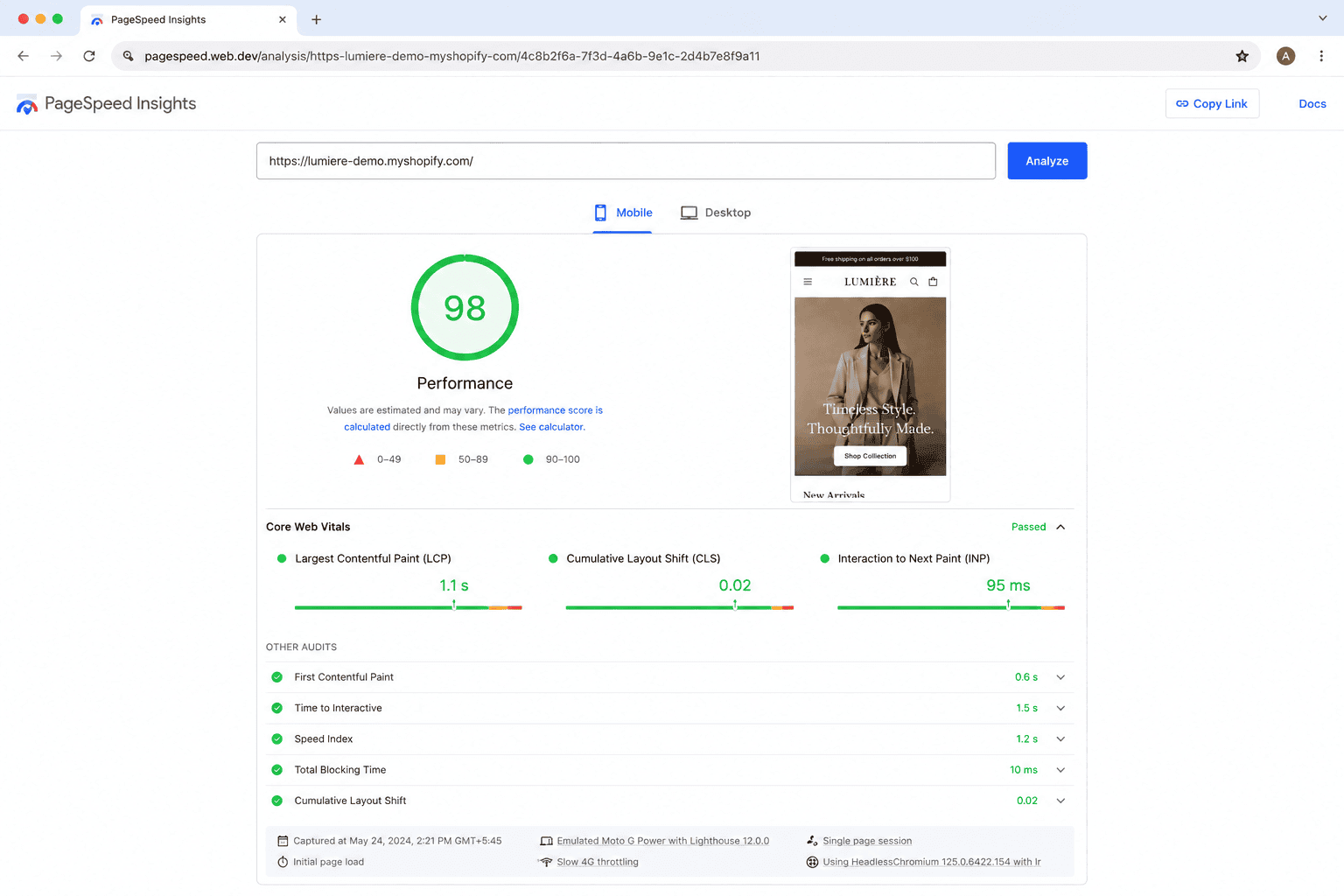
Why it matters
Speed isn't a post-launch task — it's an architecture decision.
Most slow Shopify stores weren't built slow; they were built without a performance budget and then optimised in a panic once rankings dipped. By that point the weight is structural — render-blocking CSS, oversized hero images, a dozen apps injecting scripts on every page. Building performance-first means the theme is measured against a budget at every stage, so speed is a property of the build rather than a rescue project. That matters commercially: Core Web Vitals is a confirmed Google ranking signal, and every additional second of load time measurably reduces conversion — especially on mobile, where most of your traffic is.
Sound familiar?
A slow store rarely feels slow to the people who run it.
You're on office wifi, a fast laptop and a warm cache. Your shoppers are on a mid-range Android on mobile data. These are the symptoms that surface first.
- Search Console flags your mobile pages as 'needs improvement' or 'poor' and you can't see why.
- The hero arrives late, then the page jumps as banners, badges and reviews drop in.
- Tapping a button does nothing for half a second, so shoppers tap it twice.
- You've added apps steadily for two years and nobody has ever removed one.
- You installed a speed app, the score moved a little, then quietly drifted back.
- Someone told you Shopify itself is the bottleneck, so there's nothing much to be done.
What's included
How we build for speed
A performance budget enforced through the whole build — measured on real devices and real-user data, not just Lighthouse in a fast desktop browser.
Core Web Vitals green
We build to LCP under 2.5s, CLS under 0.1 and INP under 200ms, then verify on field data rather than lab tests alone. Every image has explicit dimensions, fonts are preloaded with sensible fallbacks, and layout is reserved for late-loading elements so nothing shifts under the user's thumb.
Critical CSS & instant first paint
Above-the-fold styles are inlined so the browser can paint immediately, while the rest of the stylesheet loads without blocking. Combined with a lean DOM and minimal third-party CSS, this is what makes the store feel instant on a mid-range Android phone rather than only on a desktop connection.
Smart lazy loading
Images, video, iframes and heavy components load only as they approach the viewport, with the hero deliberately excluded so LCP isn't delayed. Below-the-fold sections never compete for bandwidth with the content the shopper is actually looking at.
Image & font pipeline
Modern formats served responsively with correct sizes attributes, so a phone requests a phone-sized image instead of a 3840px hero. Fonts are subset and preloaded with font-display swap, removing invisible-text flashes without triggering layout shift.
JavaScript discipline
No heavy frameworks shipped to the storefront for the sake of it. Scripts are deferred, split, and only loaded on templates that need them — and we audit third-party tags, because a single chat widget or review app can undo a week of optimisation work.
Monitoring after launch
We hand over Lighthouse CI plus real-user monitoring so regressions surface within hours, not quarters. Every new app or theme edit that hurts vitals gets flagged while it's still cheap to fix, which is how the score stays green a year after launch.
How it runs
How a performance build actually runs.
Roughly 4–8 weeks for a full theme, or 2–3 weeks if we're optimising what you already have — with the diagnosis done before you commit to either.
- 01
Measure before opinions
We pull 28 days of field data and profile your slowest templates on a throttled mid-range Android. You see where the milliseconds actually go before anyone writes a line of code.
- 02
Agree the budget
Hard numbers per template: JavaScript weight, image weight, request count, third-party allowance. Anything new has to displace something existing. That constraint is the whole reason the result holds.
- 03
Build to the number
Work lands in priority order, biggest win first, with the budget checked on every change. Regressions get caught the day they appear rather than in an audit six weeks later.
- 04
Launch and watch
We baseline field data before cutover, then monitor for 30 days. Field metrics move slowly, so the honest verdict arrives about four weeks after launch — not on the day.
90+
Lighthouse score
Industry avg: 60–70
< 2.5s
LCP target
Real-user data
< 0.1
CLS target
No layout shift
< 200ms
INP target
Responsive to input
Straight answer
Speed work isn't always the best thing you could spend this budget on.
A good fit if…
- Most of your traffic is mobile and your field data is already sitting amber or red.
- You rank for terms you'd like to keep, and vitals are dragging those pages down.
- You're rebuilding or redesigning anyway, so the budget can be set at the start.
- You have enough traffic that a modest conversion improvement pays for the work outright.
Probably not, if…
- Your vitals are already green — spend the money on photography or merchandising instead.
- Your traffic is small enough that a faster store won't fix what's really a demand problem.
- You won't remove any apps. We can't out-engineer a stack that only ever grows.
- You want a Lighthouse number written into the contract — nobody honest guarantees that on live third-party scripts.
Keep exploring
More on Shopify theme development
Performance-First Themes is one part of how we build Shopify themes. Here's the rest of the picture.
Shopify Theme Development
The complete service — design, build, launch and everything below, in one engagement.
View the serviceClosely relatedMobile-First Responsive Design
Most of your traffic is mobile — where performance and layout decisions matter most.
Read the guideClosely relatedCustom Theme Development
See how the full hand-coded build works, with performance budgeted from day one.
Read the guideAll guides in this series
- Theme Customization & ExtensionsCustom sections, blocks and app extensions on the theme you already run.
- Accessibility (WCAG 2.1 AA)Keyboard, screen-reader and contrast compliance built in, not bolted on.
- Conversion-Optimised PDP & PLPProduct and collection templates rebuilt around how people actually buy.
- Theme Migration & ModernisationVintage themes moved to Online Store 2.0 with no design regressions.
- Headless / Hydrogen ThemesReact storefronts on Oxygen — for when Liquid genuinely hits its ceiling.
Beyond this service
Other things we do
Most stores need two or three of these working together. Book a call and we'll tell you which ones actually move your numbers.
- Shopify Theme DevelopmentCustom themes built from Figma to production Liquid on Online Store 2.0 — fast and merchant-editable.
- Shopify App DevelopmentCustom and public apps, Checkout UI Extensions and Shopify Functions built with React and Polaris.
- Shopify MigrationMove from WooCommerce, Magento or BigCommerce with a full 301 redirect map and zero downtime.
- Shopify SEOTechnical audits, Core Web Vitals, structured data and collection content built around buyer intent.
- Shopify Performance OptimizationFaster load times and green Core Web Vitals — theme refactors, image pipelines and app cleanup.
- Shopify A/B TestingHypothesis-led experiments on product pages and checkout, shipped as native theme code.
- Shopify Email Marketing & KlaviyoFlows, segmentation and campaigns — welcome, abandoned cart, winback and SMS, built and monitored.
- Shopify CRO & FunnelsValue-ladder, tripwire, quiz and post-purchase upsell funnels built to lift conversion and AOV.
- Shopify Maintenance & SupportRetainers covering uptime monitoring, security patching, bug fixes and proactive improvements.
Frequently asked questions
- Often we can fix it in place. Image pipeline, critical CSS, script deferral and app cleanup usually recover a large share of the score without a rebuild. If the base theme is fundamentally heavy — or a page builder is generating the markup — we'll say so honestly rather than charging for optimisation that can't get you there.
Want a store that's fast by design?
Book a 30-minute technical call. We'll run your store through real-user and lab data and show you exactly where the time is going.
Book a free call