Custom Shopify Theme Development
We turn your Figma into a custom, conversion-ready Shopify theme — hand-coded in native Liquid and built around your brand instead of a template. Every section is editable by your team, and every build ships on Online Store 2.0 with a 95+ PageSpeed score.
Book a Free Technical Call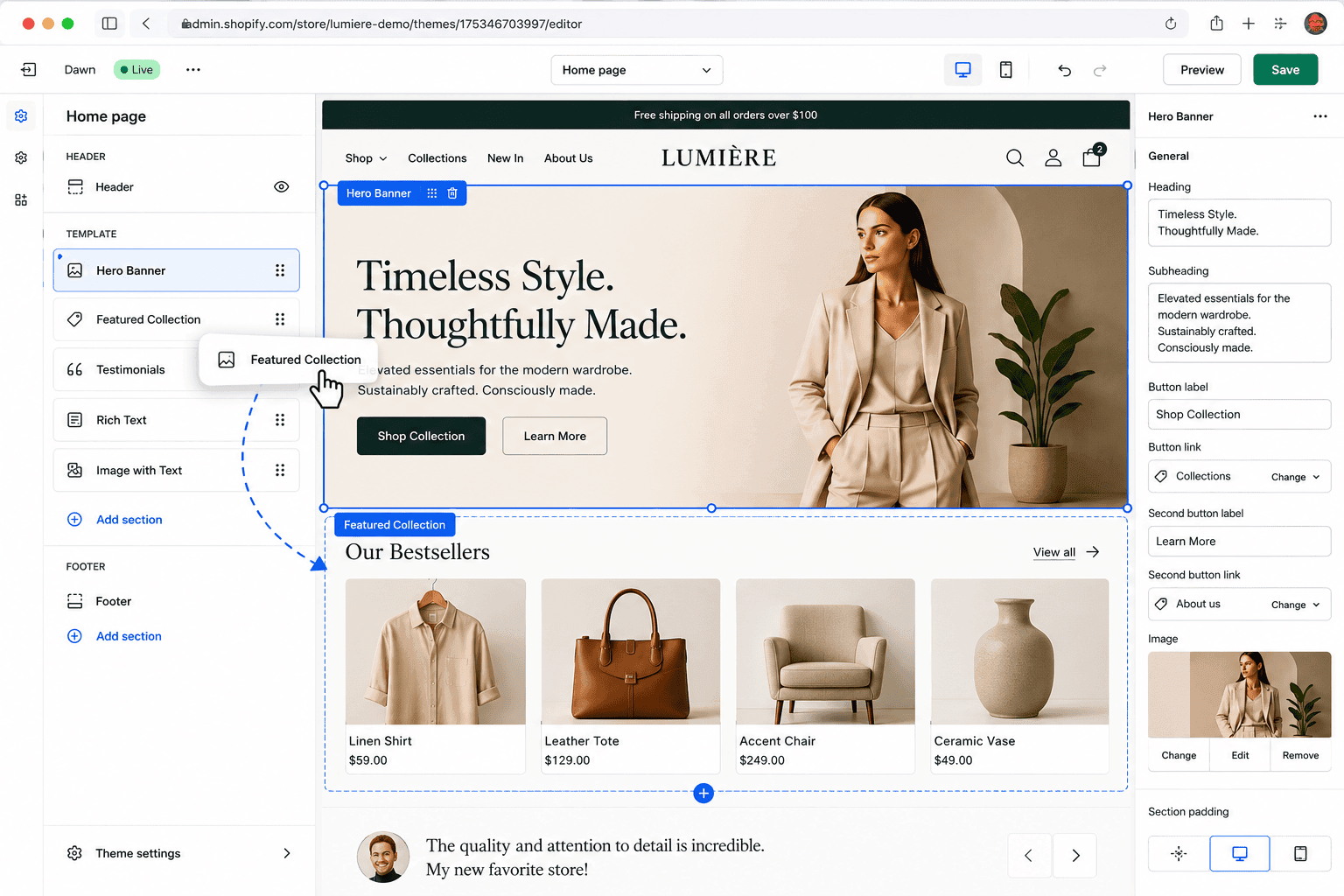
Why it matters
A theme is the one thing every visitor touches — and templates cap what it can do.
Marketplace themes are written to satisfy thousands of different stores, so they carry layout code, settings and scripts your store will never use. That dead weight slows the first paint, and every extra second of load time measurably cuts conversion. A custom theme only contains what your brand actually needs, which is why hand-coded builds consistently outperform premium templates on speed, flexibility and conversion. It also means your competitors can't buy the same storefront for $300 and look identical to you.
Sound familiar?
These are the symptoms of a theme you've outgrown.
Not all of them justify a ground-up build. Some are cheaper to solve inside the theme you already have, and we'll say so.
- Your designer handed over a Figma that no marketplace template can render without gutting half of it.
- Every campaign needs a developer because the theme editor can't build the layout your team sketched.
- You bought a premium theme, paid twice to modify it, and still aren't happy with it.
- Your store looks like three competitors because you all bought the same template last year.
- Conversion has been flat for months, so someone told you a redesign is the fix.
- Your product pages can't show the sizing, materials or comparison detail customers keep emailing you about.
What's included
What a custom theme build includes
A complete, production-grade Shopify theme — designed, hand-coded, QA'd and handed over with documentation and post-launch support.
Figma → Liquid, pixel-perfect
We translate your design file into production Liquid with the spacing, typography, motion and states preserved exactly as designed. Every breakpoint is built deliberately rather than scaled down from desktop, and we review the build against the Figma side-by-side before sign-off — so what you approved is what ships.
Clean, hand-written Liquid
Production-grade Liquid, CSS and JavaScript written to last — no bloated frameworks, no copy-pasted snippets, no page-builder dependency. Every theme passes Shopify's Theme Inspector with zero Liquid warnings, and the code is commented and named so the next developer can pick it up without guesswork.
Online Store 2.0 sections & blocks
Built entirely on the OS 2.0 architecture: sections available on every template, reusable blocks, and metafield-driven content. That means new landing pages, campaign layouts and product storytelling can be assembled by your marketing team from the theme editor — without a developer in the loop.
Merchant-editable by design
Every section exposes sensible theme-editor settings — copy, imagery, ordering, colours, visibility toggles — with clear labels and safe defaults. We deliberately avoid hard-coding content, so your team can run campaigns and refresh pages without filing a dev ticket or risking a broken layout.
Performance built in, not bolted on
Critical CSS inlined, JavaScript deferred, images served responsively in modern formats, and fonts preloaded. We budget performance during the build rather than optimising after launch, which is how these themes land 95+ PageSpeed and green Core Web Vitals on real-user data — not just lab tests.
QA, handover & post-launch support
Cross-browser and real-device QA, accessibility checks, and a full checkout-path test before we go live. You receive the Git repository, written documentation and a walkthrough session — plus 30 days of post-launch bug-fix support, because launch day is the start of the relationship, not the end.
How it runs
How a custom theme build actually runs.
Six to ten weeks from kickoff to launch for most builds, with the scope locked in week one so the timeline stops moving.
- 01
Audit and scope
We go through your current store, catalogue structure and app stack, then agree the exact template list. Anything outside it becomes a later phase instead of quiet scope creep mid-build.
- 02
Pressure-test the design
Before any code, we run the Figma against real data: 60-character product titles, sold-out variants, three-line badges, empty collections. Designs that only hold up with perfect content break in week one.
- 03
Build template by template
The theme is built on an unpublished preview and reviewed with you weekly on real URLs. You watch working pages arrive in order of priority rather than waiting for one reveal.
- 04
Launch and watch
We publish outside peak hours and confirm analytics, pixel and consent events fire on the live theme. Then we watch the first fortnight of real-user data before calling it closed.
95+
PageSpeed score
Industry avg: 60–70
0
Liquid warnings
Shopify Theme Inspector
6–10wk
Build timeline
Kickoff to launch
100%
Merchant-editable
No dev needed to update
Straight answer
A custom theme is a serious investment. It isn't always the right one.
A good fit if…
- You have a real brand identity, and a marketplace template genuinely cannot do it justice.
- Your marketing team ships campaigns often and needs sections built around how you actually sell.
- Your catalogue carries logic templates handle badly: bundles, complex variants, subscriptions, B2B pricing.
- You'll run this storefront for years, so a one-off build cost amortises sensibly.
Probably not, if…
- You're pre-launch with no traffic yet. Start on Dawn and spend the budget on demand.
- You want a fresher look, not new functionality. Customising your current theme gets you most of the way.
- Speed is your only real problem, and a performance pass on the existing theme costs far less.
- Nobody on your side owns copy, photography or maintenance once the build is handed over.
Keep exploring
More on Shopify theme development
Custom Theme Development is one part of how we build Shopify themes. Here's the rest of the picture.
Shopify Theme Development
The complete service — design, build, launch and everything below, in one engagement.
View the serviceClosely relatedTheme Customization & Extensions
Already on Dawn or a premium theme? Extend it with custom sections instead of a full rebuild.
Read the guideClosely relatedPerformance-First Themes
How we engineer Core Web Vitals into the build so speed never becomes a post-launch fix.
Read the guideAll guides in this series
- Mobile-First Responsive DesignDesigned at 375px first — where most of your traffic and revenue is.
- Accessibility (WCAG 2.1 AA)Keyboard, screen-reader and contrast compliance built in, not bolted on.
- Conversion-Optimised PDP & PLPProduct and collection templates rebuilt around how people actually buy.
- Theme Migration & ModernisationVintage themes moved to Online Store 2.0 with no design regressions.
- Headless / Hydrogen ThemesReact storefronts on Oxygen — for when Liquid genuinely hits its ceiling.
Beyond this service
Other things we do
Most stores need two or three of these working together. Book a call and we'll tell you which ones actually move your numbers.
- Shopify Theme DevelopmentCustom themes built from Figma to production Liquid on Online Store 2.0 — fast and merchant-editable.
- Shopify App DevelopmentCustom and public apps, Checkout UI Extensions and Shopify Functions built with React and Polaris.
- Shopify MigrationMove from WooCommerce, Magento or BigCommerce with a full 301 redirect map and zero downtime.
- Shopify SEOTechnical audits, Core Web Vitals, structured data and collection content built around buyer intent.
- Shopify Performance OptimizationFaster load times and green Core Web Vitals — theme refactors, image pipelines and app cleanup.
- Shopify A/B TestingHypothesis-led experiments on product pages and checkout, shipped as native theme code.
- Shopify Email Marketing & KlaviyoFlows, segmentation and campaigns — welcome, abandoned cart, winback and SMS, built and monitored.
- Shopify CRO & FunnelsValue-ladder, tripwire, quiz and post-purchase upsell funnels built to lift conversion and AOV.
- Shopify Maintenance & SupportRetainers covering uptime monitoring, security patching, bug fixes and proactive improvements.
Frequently asked questions
- Most custom themes launch in 6–10 weeks from kickoff, depending on how many templates and custom sections are in scope. A focused single-template build can ship in 3–4 weeks; a large catalog with bespoke PDP logic and B2B rules sits at the longer end. You get a firm, dated timeline after the discovery phase — not a moving target.
Ready for a theme built around your brand?
Book a 30-minute technical call. We'll review your current store or design, scope the build honestly, and tell you whether a custom theme is actually the right call.
Book a free call