Shopify Headless & Hydrogen Development
When Liquid hits its ceiling, we build Hydrogen storefronts on Shopify Oxygen — React Server Components rendered at the edge, with Shopify's native checkout and commerce APIs fully intact. You get application-grade flexibility without giving up the platform.
Book a Free Technical Call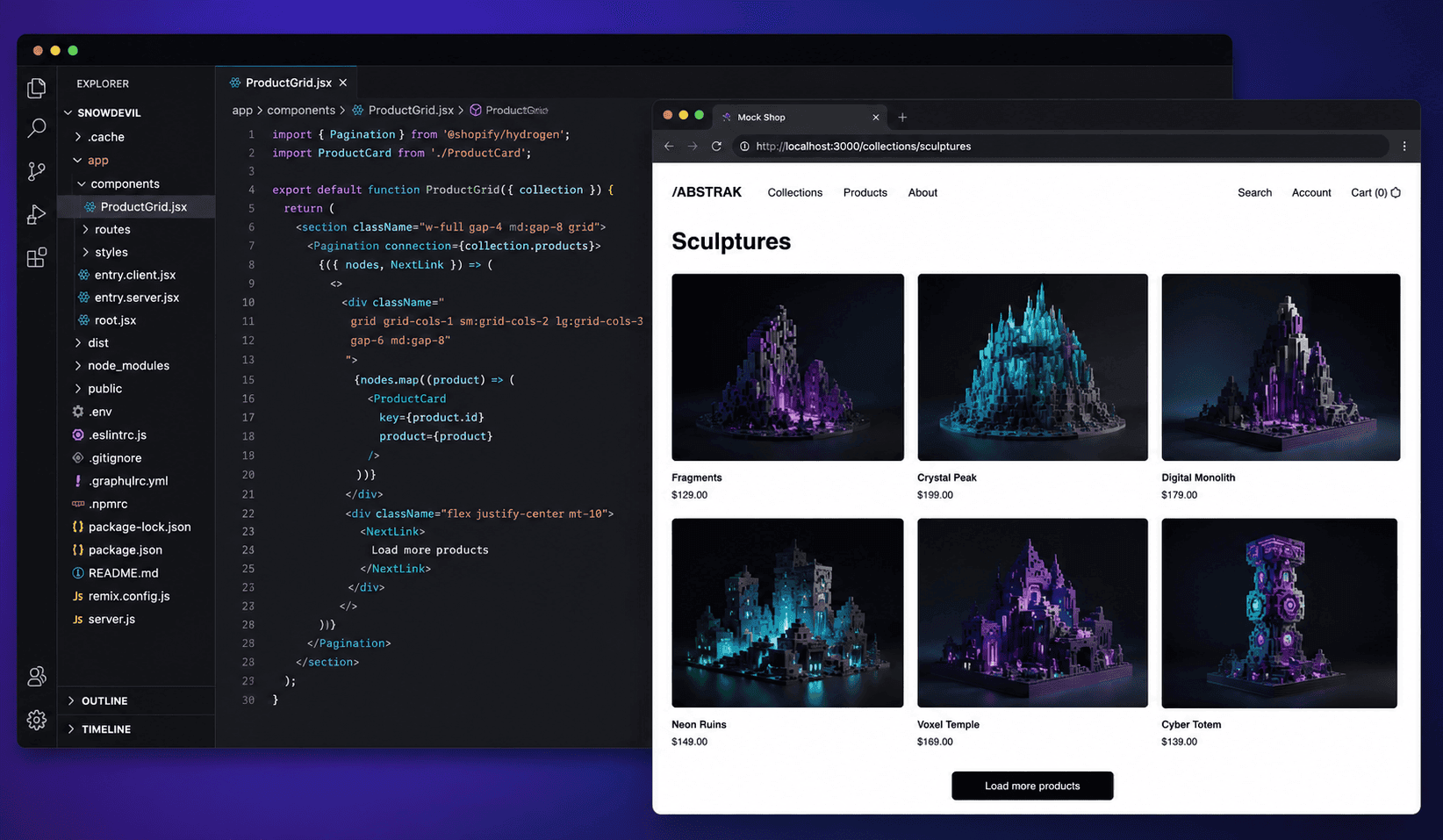
Why it matters
Headless is a serious upgrade — and the wrong answer for most stores.
Hydrogen gives you React, edge rendering and complete control over the front end, which matters when you need genuinely custom experiences: complex configurators, deep third-party data, multi-brand or multi-region storefronts, or interactions Liquid simply can't express. But it also means owning a real application — build pipelines, deployments, testing and developer time that a Liquid theme doesn't require. Our honest position is that most merchants get better returns from a fast, well-built OS 2.0 theme. We'll recommend headless when the requirements actually justify it, and tell you when they don't.
Sound familiar?
Headless usually gets raised for one of these reasons.
Some are genuinely good reasons to leave Liquid. Others are solvable inside a theme for a fraction of the cost — and we'll tell you which one you're looking at.
- You need a product configurator or quoting tool that Liquid can't realistically express.
- One storefront has to serve several brands, regions or currencies with genuinely different UX.
- Your team is a React team, and Liquid is the bottleneck on every release.
- You're pulling heavy data from a PIM, ERP or third-party service on every page view.
- Your agency said the site is slow, so the fix must be headless.
- You want an app-like storefront — instant transitions, persistent cart, offline states.
What's included
What a Hydrogen build includes
A production-grade headless storefront — architected, built and deployed on Shopify's own edge platform.
Hydrogen on Oxygen
React Server Components deployed to Shopify Oxygen's global edge network, giving millisecond TTFB worldwide without you managing infrastructure. Because it's Shopify's own hosting, you keep tight integration with the platform instead of stitching together a third-party stack.
GraphQL Storefront API
Products, collections, cart, search and customer accounts consumed through the typed Storefront API. Queries are colocated with the components that use them and fetched on the server, so the browser downloads data it needs rather than an over-fetched payload.
Native Shopify checkout
The storefront is custom; the checkout stays Shopify's. That preserves PCI compliance, Shop Pay, accelerated wallets, fraud analysis, discounts and every payment method you already accept — the parts you should never rebuild yourself.
Modern developer experience
TypeScript end to end, Tailwind for styling, Vite for fast builds, and preview deployments on every branch so stakeholders review real URLs instead of screenshots. The codebase is structured and documented so your team — or your next developer — can work in it confidently.
Performance by architecture
Server components mean less JavaScript reaches the browser, streaming gets content painted sooner, and edge caching keeps repeat visits fast. We still hold the build to the same Core Web Vitals budget as our Liquid themes — headless doesn't automatically mean fast if it's built carelessly.
SEO parity from day one
Server-rendered HTML, correct canonicals, product and breadcrumb structured data, sitemaps and metadata handled properly. Headless projects lose rankings when SEO is treated as a later concern — so we build it in and verify with Search Console before and after launch.
How it runs
How a Hydrogen build actually runs.
Roughly 10–16 weeks depending on scope, with the go/no-go decision made in week one — before you've committed real budget.
- 01
Pressure-test the decision
We map your requirements against what a well-built OS 2.0 theme can already do. If Liquid covers it, we say so and the project stops here — that outcome is a success, not a lost sale.
- 02
Architect the storefront
Route structure, Storefront API query design, caching strategy per route, and the app-parity plan for anything currently injecting UI into your theme. You approve this before code starts.
- 03
Build on Oxygen
React Server Components, TypeScript throughout, preview deployment on every branch so you review real URLs. Core Web Vitals are checked each sprint, not audited at the end.
- 04
Migrate and monitor
SEO parity verified against a pre-launch Search Console baseline, redirects in place, then 30 days of monitoring — headless projects lose rankings when this step gets rushed.
< 100ms
Edge TTFB
Shopify Oxygen, global
React
Server Components
Less JS to the browser
Native
Shopify checkout
Shop Pay & wallets intact
TypeScript
End to end
Type-safe Storefront API
Straight answer
Headless is the right call less often than the industry implies.
A good fit if…
- You have a requirement Liquid genuinely cannot express, and you can name it specifically.
- You have in-house React capability, or budget for ongoing application maintenance.
- Your catalogue and traffic justify edge rendering — this pays off at scale, not at launch.
- You're running multi-brand or multi-region storefronts that need real UX divergence.
Probably not, if…
- Your main goal is a faster site — a performance-first Liquid theme gets you there cheaper.
- You rely on several storefront apps that have no API-based equivalent.
- You have no developer resource and need marketing to edit pages without a deploy.
- You want a redesign. That's a theme project, and it will cost a fraction of this.
Keep exploring
More on Shopify theme development
Headless / Hydrogen is one part of how we build Shopify themes. Here's the rest of the picture.
Shopify Theme Development
The complete service — design, build, launch and everything below, in one engagement.
View the serviceClosely relatedPerformance-First Themes
For most stores a fast Liquid theme beats headless — here's what that looks like.
Read the guideClosely relatedCustom Theme Development
The Liquid alternative: full design freedom on Online Store 2.0, at a fraction of the cost.
Read the guideAll guides in this series
- Theme Customization & ExtensionsCustom sections, blocks and app extensions on the theme you already run.
- Mobile-First Responsive DesignDesigned at 375px first — where most of your traffic and revenue is.
- Accessibility (WCAG 2.1 AA)Keyboard, screen-reader and contrast compliance built in, not bolted on.
- Conversion-Optimised PDP & PLPProduct and collection templates rebuilt around how people actually buy.
- Theme Migration & ModernisationVintage themes moved to Online Store 2.0 with no design regressions.
Beyond this service
Other things we do
Most stores need two or three of these working together. Book a call and we'll tell you which ones actually move your numbers.
- Shopify Theme DevelopmentCustom themes built from Figma to production Liquid on Online Store 2.0 — fast and merchant-editable.
- Shopify App DevelopmentCustom and public apps, Checkout UI Extensions and Shopify Functions built with React and Polaris.
- Shopify MigrationMove from WooCommerce, Magento or BigCommerce with a full 301 redirect map and zero downtime.
- Shopify SEOTechnical audits, Core Web Vitals, structured data and collection content built around buyer intent.
- Shopify Performance OptimizationFaster load times and green Core Web Vitals — theme refactors, image pipelines and app cleanup.
- Shopify A/B TestingHypothesis-led experiments on product pages and checkout, shipped as native theme code.
- Shopify Email Marketing & KlaviyoFlows, segmentation and campaigns — welcome, abandoned cart, winback and SMS, built and monitored.
- Shopify CRO & FunnelsValue-ladder, tripwire, quiz and post-purchase upsell funnels built to lift conversion and AOV.
- Shopify Maintenance & SupportRetainers covering uptime monitoring, security patching, bug fixes and proactive improvements.
Frequently asked questions
- Probably not — and we'd rather say so upfront. Headless earns its cost when you need experiences Liquid can't express: complex configurators, heavy third-party data, multi-brand or multi-region storefronts, or an app-like front end. If your requirements are a fast, flexible, well-designed store, a custom OS 2.0 theme delivers that for far less money and ongoing effort.
Considering headless?
Book a 30-minute technical call. We'll pressure-test whether Hydrogen is genuinely right for your store — and tell you if it isn't.
Book a free call