Conversion-Optimised Shopify PDP & Collection Pages
Your product and collection pages are where browsing turns into revenue, so we design them around what actually moves the numbers — sticky galleries, clear variant selection, social proof and fast faceted filtering. Every pattern is hand-built into the theme rather than rented from an app.
Book a Free Technical Call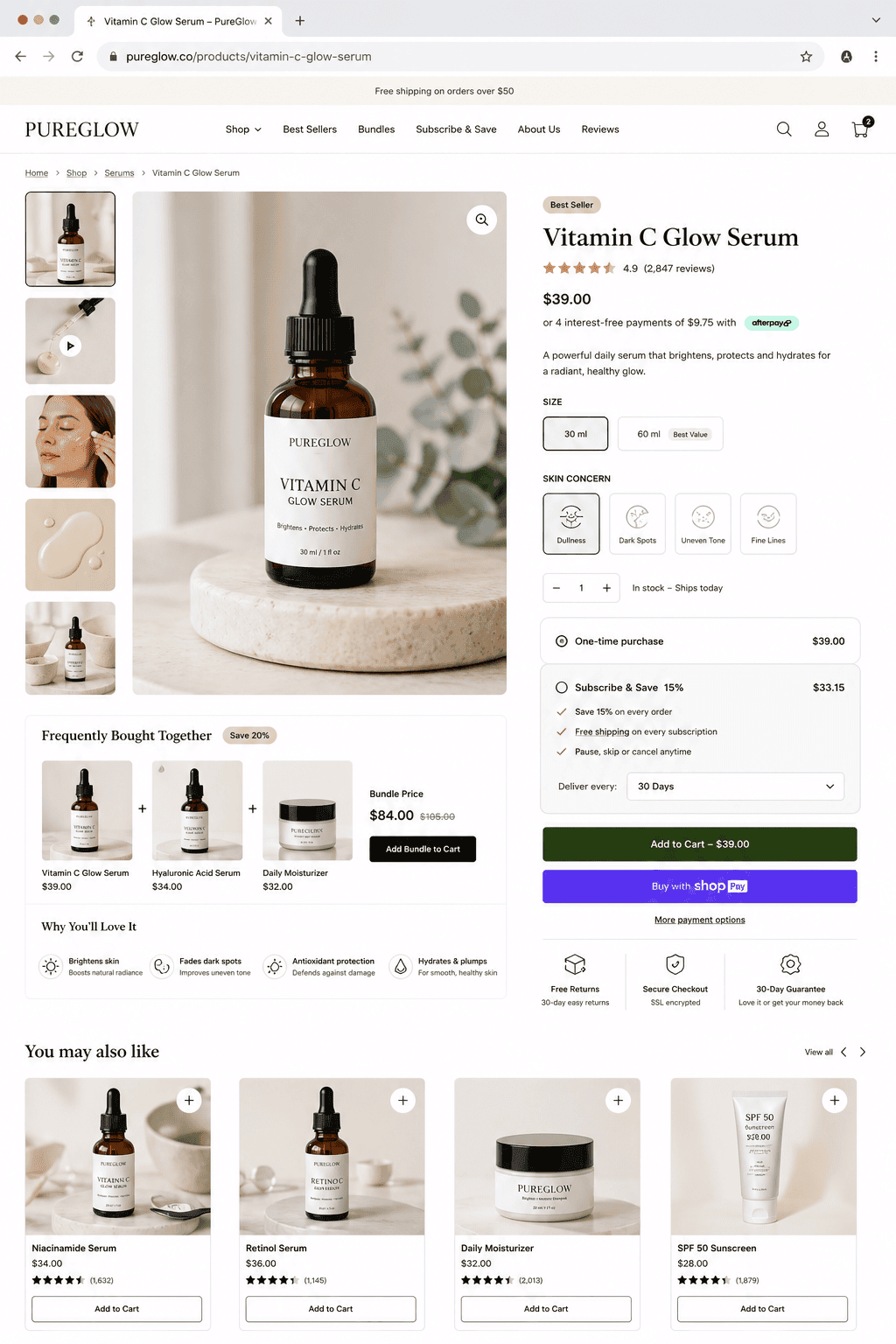
Why it matters
Two templates carry most of your revenue — and most themes treat them generically.
Almost every session that ends in a sale passes through a collection page and a product page, which makes them the highest-leverage templates in the store. Yet stock themes ship a generic PDP that buries the information shoppers need to feel confident: sizing, returns, delivery timing, and proof that other people bought it. On the collection side, slow or shallow filtering is one of the fastest ways to lose a shopper with high intent. Fixing these two templates usually produces a larger lift than a full redesign, because you're improving the exact step where hesitation turns into an exit.
Sound familiar?
Underperforming product pages fail in fairly predictable ways.
These are the patterns we see again and again. Each one points at a specific fix on a specific template — not at a redesign.
- Your product pages get steady traffic, but add-to-cart rate hasn't moved in a year.
- Shoppers open your size guide, then leave — the answer they needed isn't in there.
- Your collection filters are slow, shallow, or missing entirely below the top-level category.
- You've added a fifth conversion app and the page is slower without selling more.
- You've been told you need a full redesign when only two templates are actually underperforming.
- Support keeps answering delivery and returns questions your product page should have answered already.
What's included
What we build into PDP & PLP
The layout, logic and proof elements that reduce hesitation — placed where testing and Shopify's own data say they work.
Premium product page layouts
Sticky media galleries that keep imagery in view while the shopper reads, clear variant pickers that never leave someone guessing what's in stock, urgency and delivery cues, and collapsible detail sections for specs, sizing and returns. The add-to-cart stays reachable at every scroll position, especially on mobile.
Fast faceted collection filtering
Filtering and sorting powered by Shopify's native Search & Discovery API — no third-party filter app slowing the page or charging monthly. Filters reflect in the URL so results are shareable and indexable, and we control which filtered combinations get indexed to avoid duplicate-content dilution.
CRO patterns baked in
Trust badges, review aggregates, returns messaging and free-shipping thresholds positioned at the specific moments doubt appears — next to price, next to the buy button, and in the cart. We place them deliberately rather than scattering badges everywhere, which dilutes them.
AOV mechanics
Complete-the-look and frequently-bought-together modules, tiered quantity pricing, bundle logic and post-add cart upsells built natively into the theme. Because they're not app-injected, they load with the page rather than popping in half a second later and shifting the layout.
SEO-clean templates
Product and breadcrumb structured data, unique H1s, canonical control across filtered and paginated views, and descriptive alt text. Collection pages get real intro copy and internal links so they can rank for category terms instead of competing with one another.
Fast where it counts
The hero image is prioritised for LCP while galleries and recommendations lazy-load, filters update without a full page reload, and layout is reserved so nothing jumps as reviews and badges arrive. Speed on these two templates is worth more than anywhere else on the store.
How it runs
How a PDP and PLP rebuild runs.
Roughly 4–7 weeks for both templates, starting with a week of evidence so nothing gets redesigned on opinion.
- 01
Read the evidence
Analytics, session recordings, on-site search terms and support tickets, read together to find where intent dies. If your templates are already sound, we say so before you commit budget.
- 02
Agree the patterns
Layout, proof placement, filter facets and merchandising rules are decided up front, with the reasoning written down. You sign off on wireframes rather than reacting to a finished build.
- 03
Build it natively
Both templates are built in Liquid on a duplicate theme, with app functionality brought in-house where owning it costs less than renting it. Reviewed on a preview link before live traffic sees anything.
- 04
Ship and measure
We cut over at a quiet window, then watch add-to-cart rate, filter usage and Core Web Vitals for 30 days. Some changes win and some don't — you get told about both.
+18–32%
Conversion lift
Typical PDP/PLP rebuild
Native
Faceted filtering
Search & Discovery API
0
Filter apps needed
No monthly app fees
Schema
Product + breadcrumb
Rich-result ready
Straight answer
This is usually the highest-leverage work available — but not for every store.
A good fit if…
- You have enough traffic that a change in behaviour is readable rather than noise.
- Your products have variants, sizing or specs that genuinely need explaining before someone commits.
- You're paying monthly for filter, upsell or review apps you'd rather own outright.
- Your photography and product copy are solid, so layout is the remaining limiting factor.
Probably not, if…
- Your traffic is thin — you'd never read the result, and acquisition is the better spend.
- Your product copy is one paragraph and one image; no layout rescues thin content.
- Price, delivery cost or your returns policy is the real objection — that's a business decision.
- You want a guaranteed percentage lift in the contract; no honest agency will sign that.
Keep exploring
More on Shopify theme development
Conversion-Optimised PDP & PLP is one part of how we build Shopify themes. Here's the rest of the picture.
Shopify Theme Development
The complete service — design, build, launch and everything below, in one engagement.
View the serviceClosely relatedMobile-First Responsive Design
Most PDP traffic is mobile — the patterns that convert on a 6-inch screen.
Read the guideClosely relatedPerformance-First Themes
Speed on product and collection pages has the most direct effect on revenue.
Read the guideAll guides in this series
- Custom Theme DevelopmentFigma to production Liquid — a bespoke Online Store 2.0 theme from scratch.
- Theme Customization & ExtensionsCustom sections, blocks and app extensions on the theme you already run.
- Accessibility (WCAG 2.1 AA)Keyboard, screen-reader and contrast compliance built in, not bolted on.
- Theme Migration & ModernisationVintage themes moved to Online Store 2.0 with no design regressions.
- Headless / Hydrogen ThemesReact storefronts on Oxygen — for when Liquid genuinely hits its ceiling.
Beyond this service
Other things we do
Most stores need two or three of these working together. Book a call and we'll tell you which ones actually move your numbers.
- Shopify Theme DevelopmentCustom themes built from Figma to production Liquid on Online Store 2.0 — fast and merchant-editable.
- Shopify App DevelopmentCustom and public apps, Checkout UI Extensions and Shopify Functions built with React and Polaris.
- Shopify MigrationMove from WooCommerce, Magento or BigCommerce with a full 301 redirect map and zero downtime.
- Shopify SEOTechnical audits, Core Web Vitals, structured data and collection content built around buyer intent.
- Shopify Performance OptimizationFaster load times and green Core Web Vitals — theme refactors, image pipelines and app cleanup.
- Shopify A/B TestingHypothesis-led experiments on product pages and checkout, shipped as native theme code.
- Shopify Email Marketing & KlaviyoFlows, segmentation and campaigns — welcome, abandoned cart, winback and SMS, built and monitored.
- Shopify CRO & FunnelsValue-ladder, tripwire, quiz and post-purchase upsell funnels built to lift conversion and AOV.
- Shopify Maintenance & SupportRetainers covering uptime monitoring, security patching, bug fixes and proactive improvements.
Frequently asked questions
- Usually not. Shopify's native Search & Discovery API handles faceted filtering for the large majority of catalogs, and building on it keeps the page fast, avoids a monthly fee, and gives us control over which filtered URLs get indexed. We'd only recommend an app for genuinely unusual merchandising logic.
Want product pages that actually convert?
Book a 30-minute technical call. We'll review your PDP and collection templates and point out the friction costing you sales.
Book a free call