Shopify VSL & Long-Form Sales Funnels
Some products need ten minutes of explanation before anyone will buy. A video sales letter or long-form page gives you that room — the mechanism, the proof, the objections, the guarantee — in an order a standard product page can't hold. We build them fast, honest and measured, and we'll tell you when your catalogue doesn't warrant one.
Book a Free Technical Call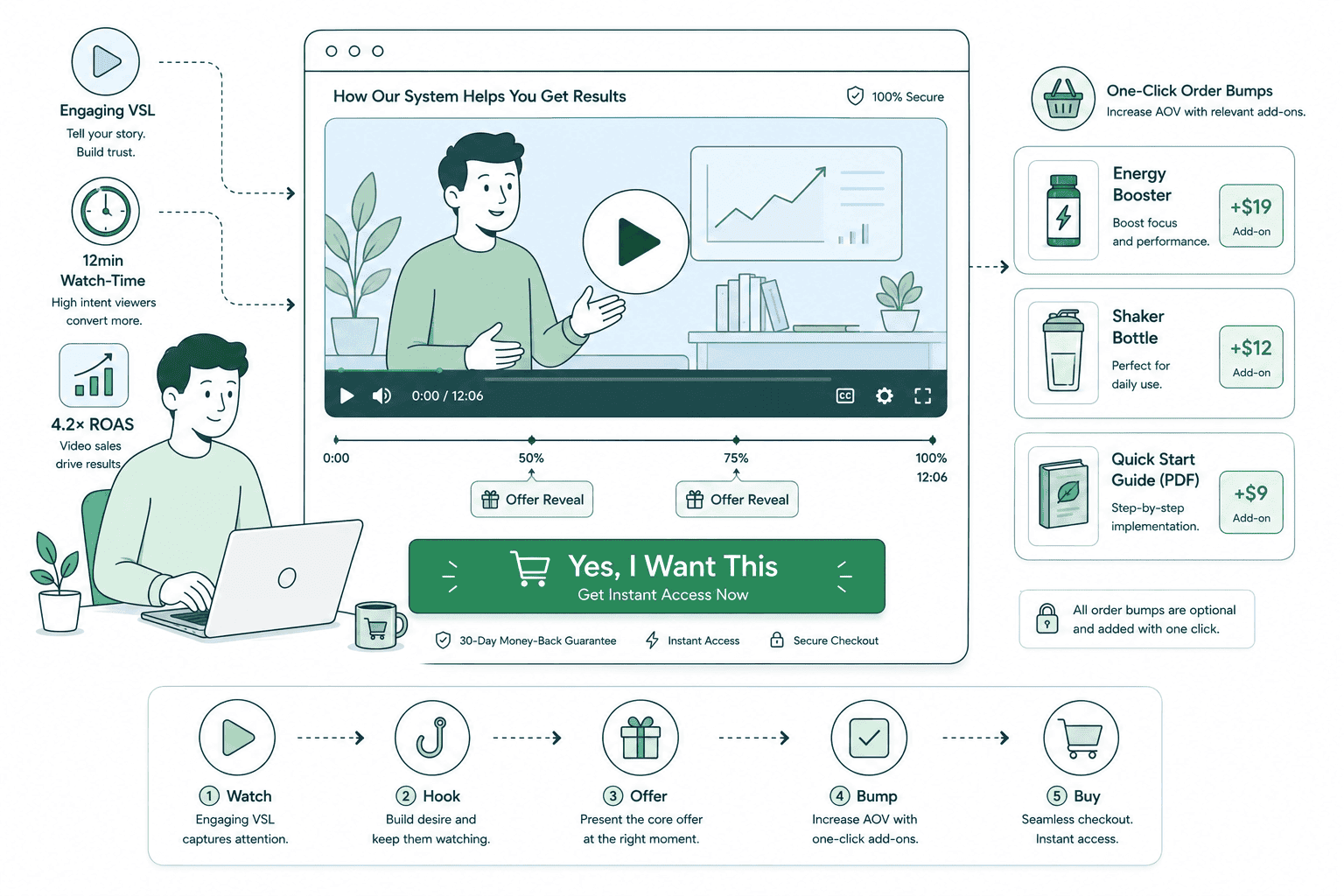
Why it matters
Long-form sells what a product page can only describe.
This is a conversion-stage asset in Shopify's funnel model. The visitor already accepts they have a problem; what they lack is enough belief to spend serious money on your particular answer to it. A VSL or long-form page exists to carry that belief — how the thing works, who it worked for, what happens if it doesn't — in a sequence a PDP has no room for. It earns its place on education-heavy, method-led or genuinely high-ticket products, where the decision is made on understanding rather than on photography. It earns nothing on a broad catalogue of familiar objects, and a two-thousand-word page selling a low-priced accessory reads as a warning sign rather than as persuasion.
Sound familiar?
Your product needs ten minutes of explanation and your PDP gives it thirty seconds.
Some of these mean long-form is the right tool. One is a belief that will waste your budget — and we'll tell you which one it is.
- Your best salesperson closes this product on a call, and the product page never manages it.
- Buyers ask the same five questions before purchasing, and your page answers none of them.
- You sell a method, programme or system, not an object anyone can judge from photographs.
- You added a video to the product page and your Largest Contentful Paint doubled overnight.
- You believe a long page always outperforms a short one — for most catalogue products it doesn't.
- Paid traffic clicks through, reads two sections and leaves long before the offer appears.
What's included
What a VSL or long-form build includes
A single page carrying the whole argument — scripted from how you actually sell, built to load fast, and instrumented so you can see where attention dies.
The argument, in order
Problem, mechanism, proof, offer, objections, guarantee. That sequence isn't decoration — it's the order a sceptical buyer needs information in. We write it from recordings of how your best seller explains the product, then cut every claim that can't be traced back to something real.
Video that doesn't wreck LCP
The video is never the Largest Contentful Paint element. A compressed poster frame paints immediately, the player loads on interaction, and the file is served from a proper host rather than a 90MB MP4 sitting in your theme assets. A VSL that costs you two seconds of load time has already lost half its audience.
Sticky, repeated CTAs
One offer, one action, restated at every natural decision point — after the mechanism, after the proof, after the guarantee — plus a sticky bar that follows the scroll on mobile. Readers convert at different depths, and a single CTA at the bottom only catches the ones who made it there.
Proof and objection handling
Named customers, real data, credentials, demonstrations, and a guarantee written in language your support team can actually honour. Objections get answered inline where they occur, not buried in a FAQ accordion at the foot of the page where nobody scrolls to find them.
Built for the phone
Most of this page will be read one thumb-length at a time. Typography sized for sustained reading, sections that break cleanly, captions burned in because a large share of viewers watch muted, and a transcript below the video for the people who would rather read than watch.
Instrumented, not guessed
Video play and completion depth, scroll depth by section, and CTA clicks attributed to the block they came from. That tells you which section people quit on, which is the only reliable way to edit a long page. Without it you're rewriting on opinion.
How it runs
How a long-form build actually runs.
Three to six weeks. Most of that is research, script and gathering proof — the page itself is the quick part.
- 01
Record how you sell
We sit with whoever closes this best — founder, practitioner, top rep — and record them explaining it end to end. Customer interviews and support tickets supply the real objections. The script comes out of that, never out of a swipe file.
- 02
Write and pressure-test
Problem, mechanism, proof, offer, objections, guarantee. Every claim gets traced to a study, a test result or a customer who agreed to be named. Anything we can't evidence is cut before it reaches a page, not after a complaint.
- 03
Build to a speed budget
Section components in your theme, lazy-loaded player, compressed poster frame, one repeated CTA, native Shopify checkout at the end. We hold the page to the same Core Web Vitals budget as any other template we ship.
- 04
Measure and cut
Two to three weeks of scroll, play-depth and CTA data, then we edit. Long-form is shaped by removal — the first version is a draft, and the sections people abandon get rewritten or deleted rather than defended.
3–6 wks
Typical build
Research, script, page, instrumentation
1 CTA
Repeated down the page
One offer, one action
6
Copy blocks
Problem through to guarantee
< 2.5s
LCP budget
Video never blocks it
Straight answer
This format suits very few Shopify catalogues. Ours included.
A good fit if…
- Your product is high-ticket, education-heavy, or sells on a method rather than on looks.
- You already close this product on calls and want the page doing that work instead.
- You have genuine proof — data, credentialed practitioners, or customers willing to be named.
- You're buying traffic and need one page to carry the entire argument end to end.
Probably not, if…
- You sell a broad catalogue of familiar products people can judge from a single photo.
- You have no proof yet, and the page would have to imply results you can't evidence.
- You want the format because a competitor uses it, not because your product needs it.
- Nobody internally will go on camera or sign off hard claims in writing.
Keep exploring
More on Shopify funnels
VSL & Long-Form Sales Funnels is one part of the funnel types we build. Here's the rest of the picture.
Shopify CRO & Funnels
The complete service — every funnel type, built native to Shopify and measured.
View the serviceClosely relatedDTC Product Funnels
The shorter sibling — a single-product landing page for products that don't need ten minutes.
Read the guideClosely relatedLead-Generation Funnels
For considered purchases, capture the email first and let a sequence do the persuading.
Read the guideAll guides in this series
- Post-Purchase Upsell FunnelsLift AOV after the card is charged, without touching checkout conversion.
- Quiz & Personalisation FunnelsTurn 'which one do I need' into a recommendation and a zero-party data capture.
- Bundle & High-AOV FunnelsBundles, volume tiers and mix-and-match that raise basket size, not discount depth.
- Subscription FunnelsConvert one-off buyers to recurring, and keep them past the third billing cycle.
- B2B & Wholesale FunnelsQuote requests, account applications and price lists — a buying process, not a cart.
Beyond this service
Other things we do
Most stores need two or three of these working together. Book a call and we'll tell you which ones actually move your numbers.
- Shopify Theme DevelopmentCustom themes built from Figma to production Liquid on Online Store 2.0 — fast and merchant-editable.
- Shopify App DevelopmentCustom and public apps, Checkout UI Extensions and Shopify Functions built with React and Polaris.
- Shopify MigrationMove from WooCommerce, Magento or BigCommerce with a full 301 redirect map and zero downtime.
- Shopify SEOTechnical audits, Core Web Vitals, structured data and collection content built around buyer intent.
- Shopify Performance OptimizationFaster load times and green Core Web Vitals — theme refactors, image pipelines and app cleanup.
- Shopify A/B TestingHypothesis-led experiments on product pages and checkout, shipped as native theme code.
- Shopify Email Marketing & KlaviyoFlows, segmentation and campaigns — welcome, abandoned cart, winback and SMS, built and monitored.
- Shopify CRO & FunnelsValue-ladder, tripwire, quiz and post-purchase upsell funnels built to lift conversion and AOV.
- Shopify Maintenance & SupportRetainers covering uptime monitoring, security patching, bug fixes and proactive improvements.
Frequently asked questions
- Only when the decision requires more information than a short page can carry. Long-form wins on unfamiliar mechanisms, high price points, considered or clinical purchases, and anything where the buyer has to understand something before they'll believe it. Short wins on familiar products, repeat purchases, and low-consideration buys where extra copy is just friction between the visitor and the button. The honest test is whether your sales team needs ten minutes to explain it. If they need thirty seconds, build a good PDP instead.
Not sure your product warrants long-form?
Book a 30-minute call. We'll look at your product, your traffic and your proof, and tell you if a good PDP would do the job for less.
Book a free call