Shopify Post-Purchase Upsell Funnels
We build offers on Shopify's native post-purchase page — the screen that appears after the card has been charged. The customer accepts in one tap without re-entering payment details, and a customer who declines still leaves you a completed order. That asymmetry is the entire reason this mechanic is worth building.
Book a Free Technical Call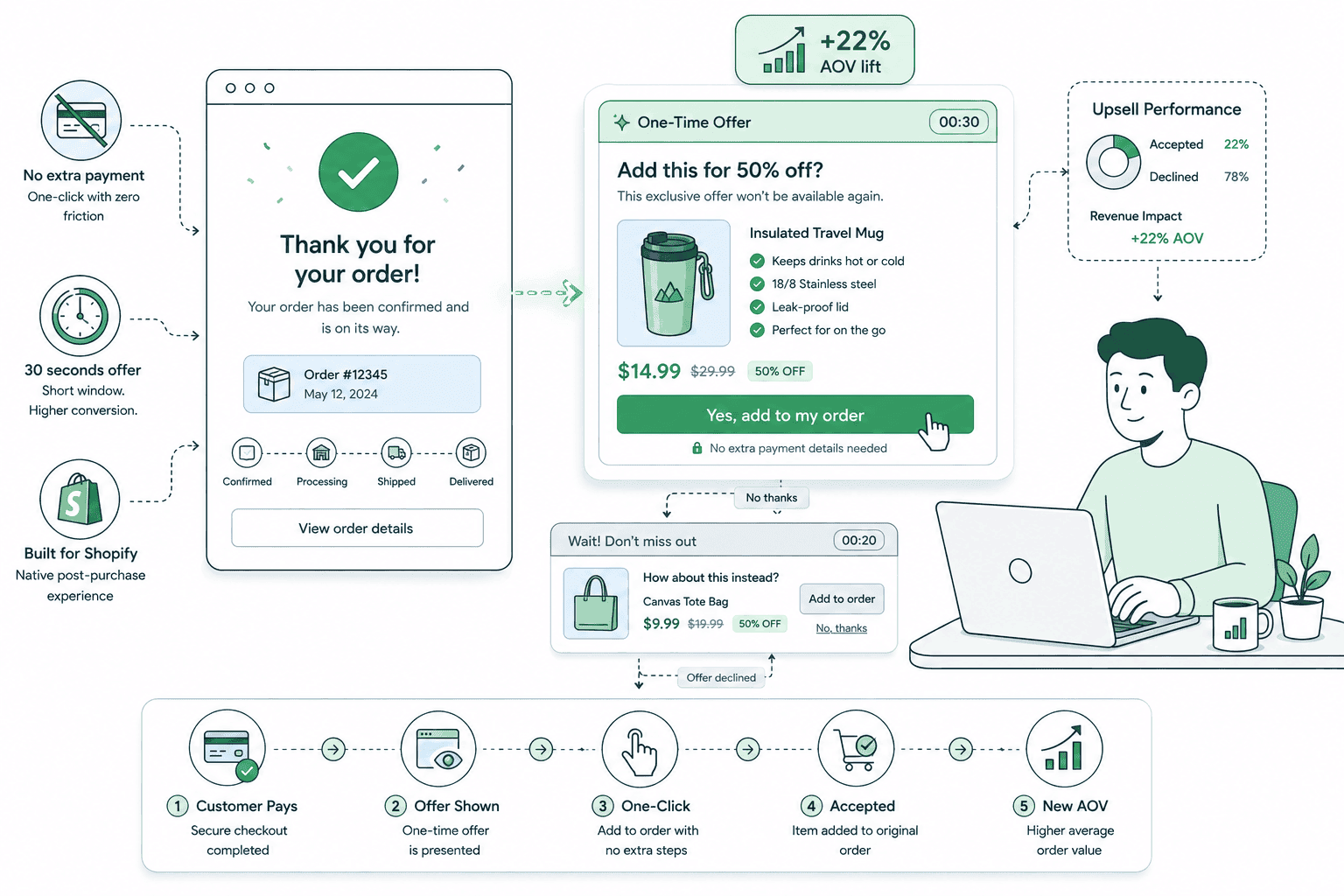
Why it matters
The offer sits after payment. That's not a detail — it's the whole argument.
In Shopify's own funnel model — awareness, consideration, conversion, checkout, retention — post-purchase upsells sit squarely at the checkout and post-purchase stage. It is the only place you can raise order value where the downside is bounded, because the order is already captured before the offer renders. Pre-purchase upsells do the opposite: cart drawers, interstitials and aggressive add-on modals inject friction at the exact moment intent peaks, and a small dip in checkout completion erases a much larger gain in average order value. We would rather add a pound to an order that already exists than risk the order itself. Everything below follows from that position.
Sound familiar?
Most upsell setups fail on offer logic, not on the app.
The app is a commodity. What gets shown, to whom, after which purchase, and whether anyone measured it — that's where the work is.
- Your average order value hasn't moved in a year while acquisition costs keep climbing.
- You added a cart-drawer upsell and checkout completion quietly dropped the week after.
- Your post-purchase offer shows the same product to everyone, whatever they just bought.
- You installed an upsell app, saw a number rise, and never ran a control group.
- You assume post-purchase offers appear on every order — they don't, and nobody has checked yours.
- Your thank-you page is a receipt, and the highest-intent moment you own goes unused.
What's included
What a post-purchase upsell funnel includes
A native Shopify post-purchase offer, built on your own order data and measured against a group that never sees it.
Shopify's native post-purchase page
Shopify's post-purchase extension renders a genuine offer page between payment and the thank-you screen. It is Shopify's own surface, not a widget bolted onto the order-status page, so the original order is captured and paid before the offer appears. Nothing you put there can cost you the sale you already made.
One-click acceptance
Payment is already authorised, so accepting takes a single tap — no card re-entry, no second checkout, no shipping form to complete again. That removed friction is most of why the mechanic works at all. We keep the accept action unambiguous and make declining just as easy to find, because dark patterns cost you the next order.
Offer logic driven by the order
What appears depends on what was just bought: product, variant, order value, and whether this is a repeat customer. The refill for the consumable, the accessory that matches the model, the size up. Generic best-seller offers get ignored, and ignored offers teach customers to skip the page on every future order.
Order bumps, used sparingly
An order bump is a small pre-payment add-on — a tick box in the cart, typically cheap and low-consideration. Different mechanic, different risk: it sits inside the buying flow, so it has to be tiny and obviously relevant. Upsell blocks on checkout itself need checkout extensibility and a Plus plan. We use bumps as a supporting move, never the main offer.
Payment-method coverage, tested
Post-purchase offers do not render on every order. Several accelerated wallets, local gateways and deferred payment methods skip the extension entirely, and some multi-currency setups behave differently again. We test your real payment paths and tell you what share of orders will never see the offer, before you build anything around it.
Measured against a holdout
A slice of orders is excluded from the offer so you have something honest to compare against. We watch average order value, take rate, refund rate and support volume together — an offer that raises basket size while raising returns has not earned its place, and only a control group makes that visible.
How it runs
How we build a post-purchase funnel.
Two to four weeks from kickoff for a first funnel, most of it spent on offer logic and measurement rather than on the build itself.
- 01
Read the order data
We pull ninety days of orders and find what genuinely gets bought together, at what price gap, and how often people come back. Offer logic comes out of your data, not from a template someone published last week.
- 02
Design the offer
One offer per order, selected by what was just purchased. Clear price framing, a concrete reason to add it now rather than later, and a decline that behaves like a decline instead of a trap.
- 03
Build and test coverage
We build the post-purchase extension, then test it across payment methods, mobile, multi-item orders and discounted orders — including every case where the offer legitimately cannot render, so nothing surprises you at launch.
- 04
Run against a control
A holdout group sees no offer. We compare order value, refund rate and support tickets across both groups over a readable window, then keep, rework or remove the offer on that evidence.
1-click
Acceptance
No card details re-entered
0
Checkout risk
Offer renders after payment
2–4 wks
Build time
Per funnel, from kickoff
1
Post-purchase slot
Shopify allows one, per order
Straight answer
Post-purchase upsells suit some catalogues and waste money on others.
A good fit if…
- You sell consumables, accessories or companions that genuinely pair with what people already buy.
- Your monthly order volume is high enough for a holdout test to read clearly within weeks.
- Your margins allow a discounted add-on without the incremental unit costing you money.
- The basics are already sound — product pages, shipping clarity, checkout speed — and order value is next.
Probably not, if…
- You sell one product with no natural companion, and inventing one would only confuse buyers.
- Your order volume is low enough that any test result stays statistical noise for months.
- You want the upsell before payment because it converts better — we won't build that trade.
- Fulfilment or returns already strain at current volume; more items per order makes it worse.
Keep exploring
More on Shopify funnels
Post-Purchase Upsell Funnels is one part of the funnel types we build. Here's the rest of the picture.
Shopify CRO & Funnels
The complete service — every funnel type, built native to Shopify and measured.
View the serviceClosely relatedBundle & High-AOV Funnels
The pre-purchase route to a bigger basket — bundles and volume tiers, with the margin checked first.
Read the guideClosely relatedSubscription Funnels
Turn a one-off buyer into a recurring one, and keep them past the third billing cycle.
Read the guideAll guides in this series
- Quiz & Personalisation FunnelsTurn 'which one do I need' into a recommendation and a zero-party data capture.
- Lead-Generation FunnelsCapture the 97% who leave without buying, with an offer worth an email address.
- DTC Product FunnelsSingle-product landing pages built to sell one thing properly, not browse a catalogue.
- B2B & Wholesale FunnelsQuote requests, account applications and price lists — a buying process, not a cart.
- VSL & Long-Form Sales FunnelsVideo and long-form pages for considered purchases that a product page can't carry.
Beyond this service
Other things we do
Most stores need two or three of these working together. Book a call and we'll tell you which ones actually move your numbers.
- Shopify Theme DevelopmentCustom themes built from Figma to production Liquid on Online Store 2.0 — fast and merchant-editable.
- Shopify App DevelopmentCustom and public apps, Checkout UI Extensions and Shopify Functions built with React and Polaris.
- Shopify MigrationMove from WooCommerce, Magento or BigCommerce with a full 301 redirect map and zero downtime.
- Shopify SEOTechnical audits, Core Web Vitals, structured data and collection content built around buyer intent.
- Shopify Performance OptimizationFaster load times and green Core Web Vitals — theme refactors, image pipelines and app cleanup.
- Shopify A/B TestingHypothesis-led experiments on product pages and checkout, shipped as native theme code.
- Shopify Email Marketing & KlaviyoFlows, segmentation and campaigns — welcome, abandoned cart, winback and SMS, built and monitored.
- Shopify CRO & FunnelsValue-ladder, tripwire, quiz and post-purchase upsell funnels built to lift conversion and AOV.
- Shopify Maintenance & SupportRetainers covering uptime monitoring, security patching, bug fixes and proactive improvements.
Frequently asked questions
- It shouldn't, because the offer renders after payment has been taken. The order is captured whether or not the customer accepts, so declining costs you nothing. That is the reason we favour post-purchase offers over cart and checkout upsells: the pre-purchase versions add friction while the sale is still in the balance, and a one-point drop in checkout completion can easily outweigh a much larger rise in average order value.
Want more from the order you've already won?
Book a 30-minute call. We'll look at your order data and payment mix, and tell you whether a post-purchase offer is worth building on your store.
Book a free call