Shopify DTC Product Funnels
A standard product page is built for a shopper browsing your catalogue. Paid traffic isn't browsing — it clicked one specific promise. A DTC product funnel is a dedicated page that continues that promise, answers the objections in order, and leaves exactly one thing to do.
Book a Free Technical Call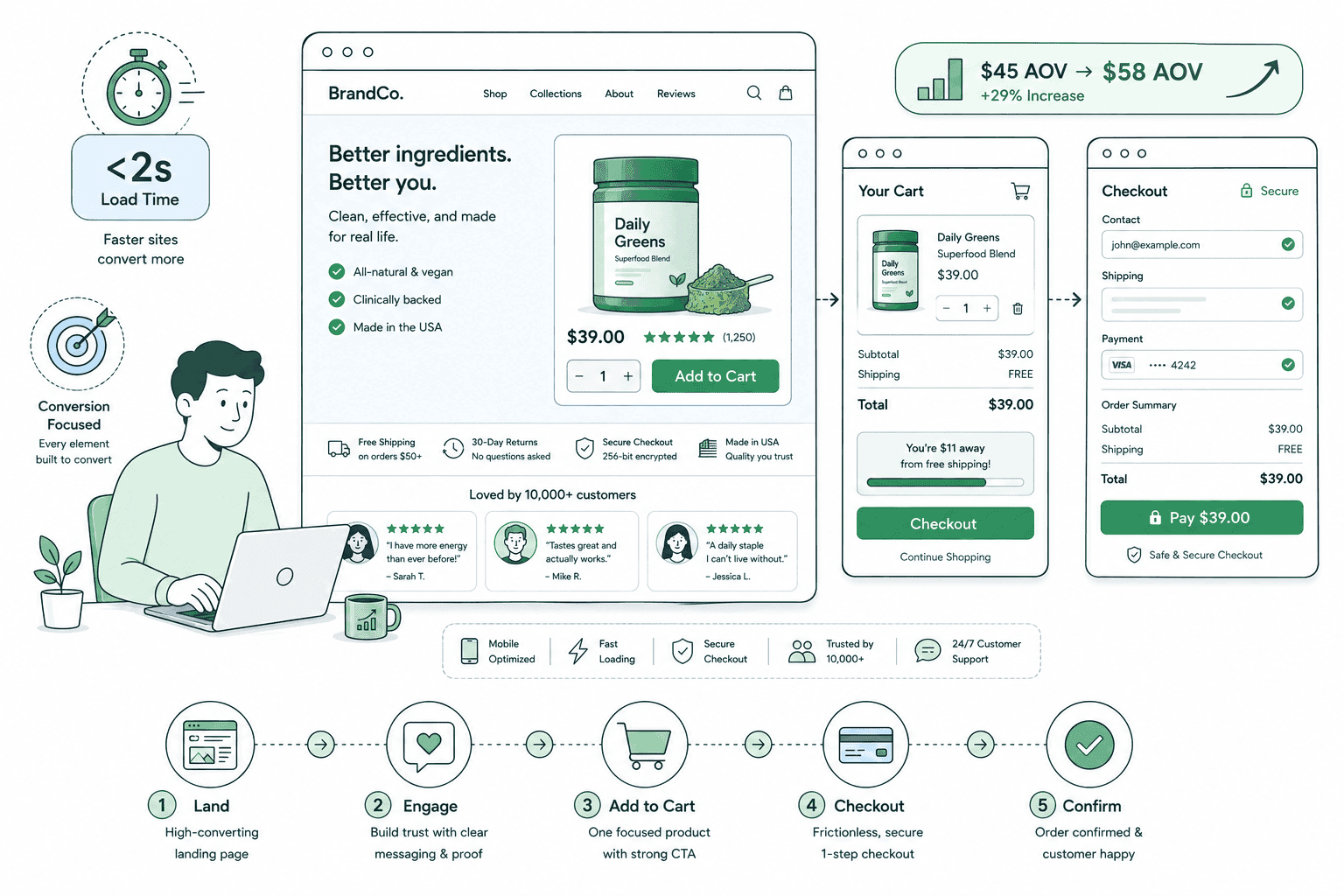
Why it matters
Paid traffic doesn't want your catalogue. It wants the thing in the ad.
DTC product funnels live at the conversion stage of Shopify's own funnel model — awareness, consideration, conversion, checkout, retention. The visitor already knows what they came for; the only question is whether this page removes enough doubt to justify the purchase. A standard PDP is built for a different job: it serves organic search, returning customers and browsers, so it carries navigation, related products, collection links and cross-sells. Every one of those is an exit for someone who arrived with a single intent. A funnel page removes the exits, matches the language of the ad that brought them, and sequences proof against objections. It is not a better page in general — it is a page built for one source of traffic and one decision.
Sound familiar?
Your ads are working and the landing page is where the money leaks.
These are page problems, not traffic problems. One of them is an assumption that sends good money after a bad product.
- Click-through rates on your ads look fine, but the landing page converts far below your site average.
- Ad traffic arrives on a generic PDP that says nothing about the promise in the creative.
- Session recordings show paid visitors exploring the menu, then leaving without seeing the offer.
- You assume a better funnel page will rescue a product that has never sold organically either.
- Your funnel pages live in a third-party builder that's slow, off-brand and impossible to edit.
- Every product on the page competes with three related products and a collection link.
What's included
What a DTC product funnel includes
One product, one argument, one action — built native to Shopify rather than bolted on with a third-party page builder.
Message match with the ad
The headline, the hero image and the offer continue the creative that earned the click. When the ad promises one thing and the page opens with your brand story, the visitor has to re-orient — and a meaningful share of them leave instead. We map every live creative to the page section that answers it.
Objection handling in order
Buyers hesitate in a predictable sequence: does it work, will it suit me, what if it doesn't, how long until it arrives, why this price. We write the page in that order so each doubt is answered where it surfaces, rather than piled into an FAQ accordion at the bottom.
Social proof where the doubt is
Reviews are near-useless as a block of stars under the fold. Specific proof placed next to the specific claim it supports does the work: a durability review beside the materials section, a sizing quote beside the size selector, UGC beside the claim it demonstrates.
One CTA, stripped navigation
No mega-menu, no related products, no collection links, no chat widget competing for attention. The same call to action repeats down the page so the visitor can act at whichever point they're convinced, and every button says the same thing and does the same thing.
Direct-to-checkout or cart, tested
Skipping the cart removes a step, which usually helps a single-product funnel. It also removes the place people add a second item, which can cost you AOV. We build both paths, decide with your data rather than a rule of thumb, and keep Shop Pay and wallets available either way.
Mobile speed as a conversion lever
Paid social traffic is overwhelmingly mobile and impatient. Long-form funnel pages get heavy fast — video, testimonials, image galleries. We build on Liquid sections with lazy loading and a real performance budget, and hold the page to Core Web Vitals thresholds under load.
How it runs
How we build a DTC product funnel.
Two to four weeks for the first funnel — longer if the offer and proof still need to be found rather than just assembled.
- 01
Audit the offer
Existing conversion data, ad creative, reviews and support tickets. If the product converts poorly from every source, we say so before you spend on a funnel page that can only dress up the same problem.
- 02
Write the argument
Objections ranked by how often they actually stop a purchase, then the page written in that order. Copy comes first; the layout serves it. Every claim is matched to a specific piece of proof we can point to.
- 03
Build native to Shopify
A dedicated Liquid template with reusable sections, stripped navigation and one repeated CTA. Your team can edit copy and swap proof in the theme editor without a developer or a page-builder subscription.
- 04
Instrument and iterate
Analytics, scroll and CTA tracking by ad source, so you can see which creative sends traffic that converts. We change one element at a time and hold changes long enough to read them honestly.
1
Product per page
No catalogue, no cross-sell
1 CTA
Repeated down the page
Same words, same action
2–4 wks
Per funnel build
Offer audit to live page
0
Page builders installed
Native Liquid sections only
Straight answer
A funnel page won't fix a product nobody wants.
A good fit if…
- You have one or two hero products carrying most of the revenue and most of the ad spend.
- You're running meaningful paid traffic and can already see where it drops on the current page.
- Your product needs explaining — a benefit, a mechanism or a comparison the PDP can't carry.
- You'll keep iterating after launch rather than treating the page as finished at handover.
Probably not, if…
- The product converts poorly from organic and email too — that's a product or offer problem.
- Your catalogue is wide and no single product justifies a dedicated page and its upkeep.
- You want a funnel page purely because a competitor has one, with no traffic to send it.
- Nobody owns the ad account, so message match will drift the moment creative changes.
Keep exploring
More on Shopify funnels
DTC Product Funnels is one part of the funnel types we build. Here's the rest of the picture.
Shopify CRO & Funnels
The complete service — every funnel type, built native to Shopify and measured.
View the serviceClosely relatedVSL & Long-Form Sales Funnels
When the argument needs video or several thousand words instead of a single page.
Read the guideClosely relatedBundle & High-AOV Funnels
Raise basket size once the single-product page is already converting properly.
Read the guideAll guides in this series
- Post-Purchase Upsell FunnelsLift AOV after the card is charged, without touching checkout conversion.
- Quiz & Personalisation FunnelsTurn 'which one do I need' into a recommendation and a zero-party data capture.
- Subscription FunnelsConvert one-off buyers to recurring, and keep them past the third billing cycle.
- Lead-Generation FunnelsCapture the 97% who leave without buying, with an offer worth an email address.
- B2B & Wholesale FunnelsQuote requests, account applications and price lists — a buying process, not a cart.
Beyond this service
Other things we do
Most stores need two or three of these working together. Book a call and we'll tell you which ones actually move your numbers.
- Shopify Theme DevelopmentCustom themes built from Figma to production Liquid on Online Store 2.0 — fast and merchant-editable.
- Shopify App DevelopmentCustom and public apps, Checkout UI Extensions and Shopify Functions built with React and Polaris.
- Shopify MigrationMove from WooCommerce, Magento or BigCommerce with a full 301 redirect map and zero downtime.
- Shopify SEOTechnical audits, Core Web Vitals, structured data and collection content built around buyer intent.
- Shopify Performance OptimizationFaster load times and green Core Web Vitals — theme refactors, image pipelines and app cleanup.
- Shopify A/B TestingHypothesis-led experiments on product pages and checkout, shipped as native theme code.
- Shopify Email Marketing & KlaviyoFlows, segmentation and campaigns — welcome, abandoned cart, winback and SMS, built and monitored.
- Shopify CRO & FunnelsValue-ladder, tripwire, quiz and post-purchase upsell funnels built to lift conversion and AOV.
- Shopify Maintenance & SupportRetainers covering uptime monitoring, security patching, bug fixes and proactive improvements.
Frequently asked questions
- Often that's exactly what you should do, and we'll say so if your traffic is mostly organic and returning customers. A dedicated funnel page earns its keep when you're sending significant paid traffic with a specific promise, because the PDP has to serve browsers as well and can't be stripped down without hurting them. Keep both: the PDP for the catalogue, the funnel page for the campaign.
Sending paid traffic to a page that isn't converting?
Book a 30-minute call. We'll review the ad, the landing page and the numbers — and tell you if the problem is the page or the offer.
Book a free call