Shopify Product Quiz & Personalisation Funnels
A product quiz earns its place when choosing is genuinely hard — skincare, supplements, fit, tools, anything with forty variants and no obvious entry point. We build the question logic, tie every recommendation to real inventory, and route the answers into Klaviyo as segments you can actually use. On a small, self-explanatory catalogue, we'll tell you not to bother.
Book a Free Technical Call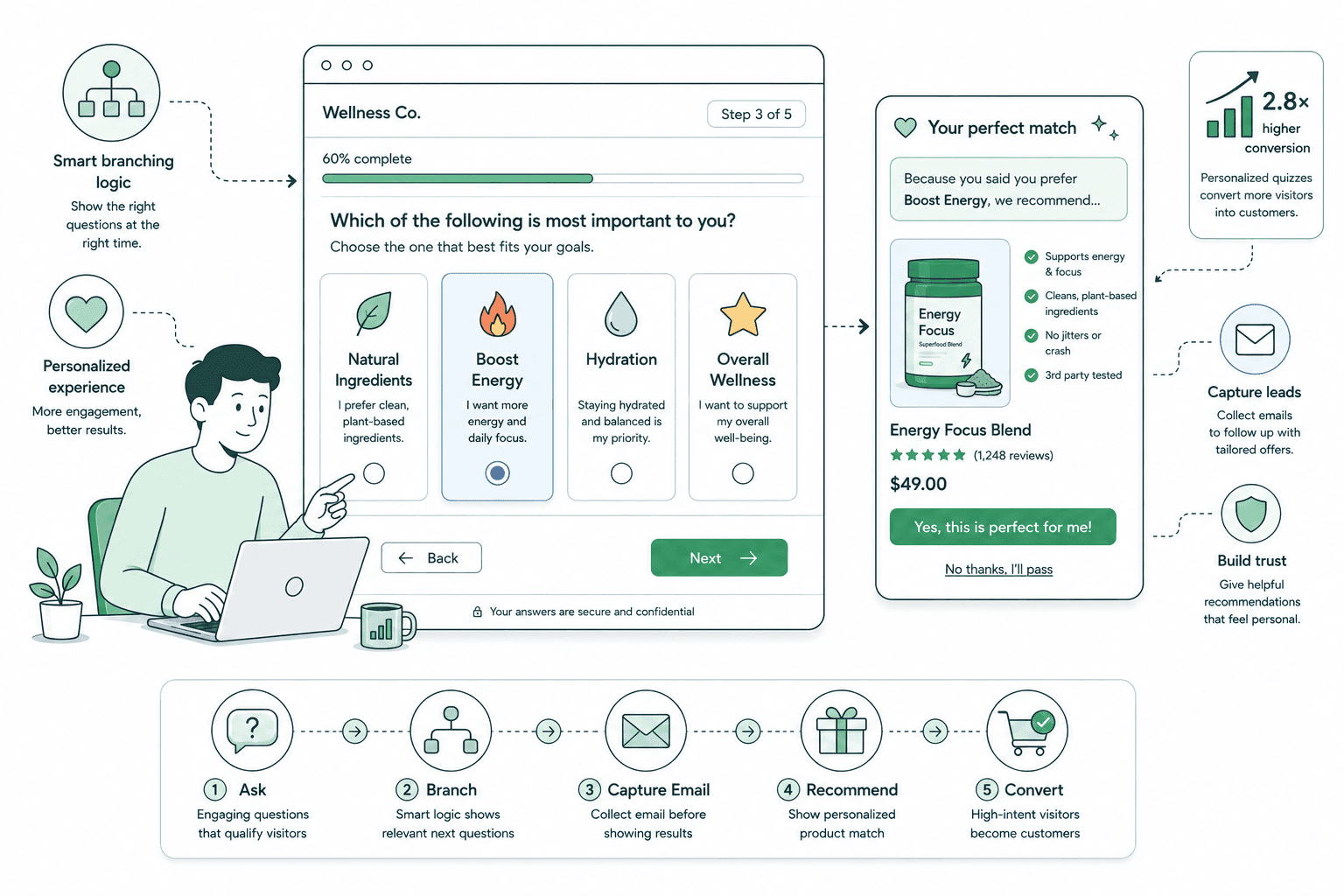
Why it matters
A quiz replaces a decision the customer can't make on their own.
In Shopify's funnel model — awareness, consideration, conversion, checkout, retention — a quiz lives at the consideration stage. It exists for the visitor who wants to buy but cannot work out which product is theirs, and who would otherwise leave to research, ask a friend, or simply not decide. Done properly it does two jobs at once: it narrows a confusing catalogue to one confident recommendation, and it collects zero-party data — stated preferences, skin type, goal, experience level — that no tracking pixel can infer for you. Done badly it's a personality test with a discount at the end, and it converts worse than a good comparison table.
Sound familiar?
Quizzes fail for reasons that have nothing to do with the design.
They're usually beautiful. The problem is question logic, inventory drift, or a catalogue that never needed one.
- Your support inbox is full of 'which one should I buy?' before anyone reaches the checkout.
- You sell forty variants of a product people only really understand after using it once.
- Your quiz gets started often and finished rarely, and nobody has looked at where people drop.
- You believe a quiz will fix conversion on a six-product catalogue that's already clear.
- Your results page recommends products that went out of stock several weeks ago.
- You collect quiz answers and none of them reach Klaviyo as a segment you can send to.
What's included
What a quiz funnel includes
Question logic, recommendation rules, data plumbing and a cart handoff — built as one system, not a widget dropped on a page.
Built for catalogues where choosing is hard
Skincare with skin types and concerns. Supplements with goals and stacks. Fit-dependent apparel, tools graded by job, anything where two products differ in ways the buyer can't see from a photo. The harder the decision, the more a quiz earns. That is the first thing we check, before any design work starts.
Questions that qualify, not entertain
Every question either changes the recommendation or feeds a segment worth having. If it does neither, it comes out. That rules out the personality-quiz filler that inflates completion metrics and tells you nothing — and it keeps the quiz short enough that people finish it on a phone in a queue.
Recommendation logic tied to real stock
Answers map to actual SKUs and variants, checked against live availability. No path returns nothing, and no path recommends a product that has been out of stock for a fortnight. We write the rules with you, document them, and leave them editable — because your catalogue will change and the logic has to move with it.
Zero-party data into Klaviyo
Answers are pushed to Klaviyo as profile properties, so segments come from what customers told you rather than what a model guessed. Skin type, goal, budget band, experience level. That turns a quiz into a permanent segmentation asset that keeps paying into flows and campaigns long after the visit ends.
Quiz-to-cart handoff
The result page adds the recommendation to the cart in one action, with the reasoning visible — why this one, what it does, what to expect. Most quizzes leak here, dumping people onto a collection page to start choosing again. That's the exact problem the quiz was meant to solve.
Mobile completion, watched question by question
Most quiz traffic is mobile, and drop-off concentrates on specific questions — usually the long one, the one asking something personal, or the one with eight options. We instrument each step, then cut or rewrite whatever bleeds. Question count is a design constraint, not a wish list.
How it runs
How we build a quiz funnel.
Three to five weeks, depending on catalogue complexity and how settled your recommendation rules already are.
- 01
Map the real decision
We sit with whoever answers customer questions all day and write down how they actually advise people. That conversation becomes the recommendation logic. If nobody can explain why one product suits a customer better, the quiz has no foundation.
- 02
Write the questions
Each question is justified by the rule it feeds. We order them so the easiest come first, keep options to a scannable number, and cut anything that exists only to make the quiz feel thorough.
- 03
Wire logic and data
Rules mapped to live SKUs, results built against real inventory, answers pushed to Klaviyo as profile properties. We test every path, including the odd combinations, so no answer set returns an empty screen.
- 04
Watch, then cut
After launch we read step-by-step completion on mobile and desktop. Questions that lose people get rewritten or removed, and recommendation rules get corrected against what people actually bought afterwards.
5–8
Questions
Our working ceiling on mobile
0
Dead-end results
Every path returns real stock
3–5 wks
Build time
Logic, design, integrations
1-tap
Result to cart
No second choice to make
Straight answer
A quiz on the wrong catalogue is theatre.
A good fit if…
- Your catalogue is large or technical enough that customers genuinely struggle to self-select.
- You have real attributes — skin type, fit, use case, experience — to route a recommendation on.
- You want zero-party data for segmentation, not just another email capture behind a discount.
- Someone on your side can own the recommendation rules as products come and go.
Probably not, if…
- You sell six products. A clear comparison table will do more, faster, for far less.
- The quiz would exist mainly to collect emails — build a lead-generation offer instead.
- Nobody internally can explain why one product suits a customer better than another.
- Your stock data is unreliable; recommending unavailable products costs more trust than the quiz builds.
Keep exploring
More on Shopify funnels
Quiz & Personalisation Funnels is one part of the funnel types we build. Here's the rest of the picture.
Shopify CRO & Funnels
The complete service — every funnel type, built native to Shopify and measured.
View the serviceClosely relatedLead-Generation Funnels
If the goal is really the email address, an offer beats a quiz — here's what that looks like.
Read the guideClosely relatedDTC Product Funnels
When one product does the selling, a dedicated landing page carries it better than a catalogue.
Read the guideAll guides in this series
- Post-Purchase Upsell FunnelsLift AOV after the card is charged, without touching checkout conversion.
- Bundle & High-AOV FunnelsBundles, volume tiers and mix-and-match that raise basket size, not discount depth.
- Subscription FunnelsConvert one-off buyers to recurring, and keep them past the third billing cycle.
- B2B & Wholesale FunnelsQuote requests, account applications and price lists — a buying process, not a cart.
- VSL & Long-Form Sales FunnelsVideo and long-form pages for considered purchases that a product page can't carry.
Beyond this service
Other things we do
Most stores need two or three of these working together. Book a call and we'll tell you which ones actually move your numbers.
- Shopify Theme DevelopmentCustom themes built from Figma to production Liquid on Online Store 2.0 — fast and merchant-editable.
- Shopify App DevelopmentCustom and public apps, Checkout UI Extensions and Shopify Functions built with React and Polaris.
- Shopify MigrationMove from WooCommerce, Magento or BigCommerce with a full 301 redirect map and zero downtime.
- Shopify SEOTechnical audits, Core Web Vitals, structured data and collection content built around buyer intent.
- Shopify Performance OptimizationFaster load times and green Core Web Vitals — theme refactors, image pipelines and app cleanup.
- Shopify A/B TestingHypothesis-led experiments on product pages and checkout, shipped as native theme code.
- Shopify Email Marketing & KlaviyoFlows, segmentation and campaigns — welcome, abandoned cart, winback and SMS, built and monitored.
- Shopify CRO & FunnelsValue-ladder, tripwire, quiz and post-purchase upsell funnels built to lift conversion and AOV.
- Shopify Maintenance & SupportRetainers covering uptime monitoring, security patching, bug fixes and proactive improvements.
Frequently asked questions
- On a catalogue where choosing is genuinely hard, it can — because it removes the decision that was stopping people. On a small or self-explanatory catalogue it usually doesn't, and can slow buyers down by adding a step between them and the product. We won't quote you a number, because the result depends almost entirely on how confused your customers were to begin with. That's the thing worth diagnosing first.
Not sure a quiz is the right fix?
Book a 30-minute call. We'll look at your catalogue and the questions your support team keeps answering, and tell you honestly whether a quiz would earn its build.
Book a free call