Shopify Bundle & High-AOV Funnels
Bundles raise basket size before the customer reaches checkout — fixed sets, mix-and-match, build-your-own and volume tiers. The build is the easy part. The work that matters is deciding the mechanic, setting discount depth against real margin, and keeping component inventory honest once one order pulls from four SKUs.
Book a Free Technical Call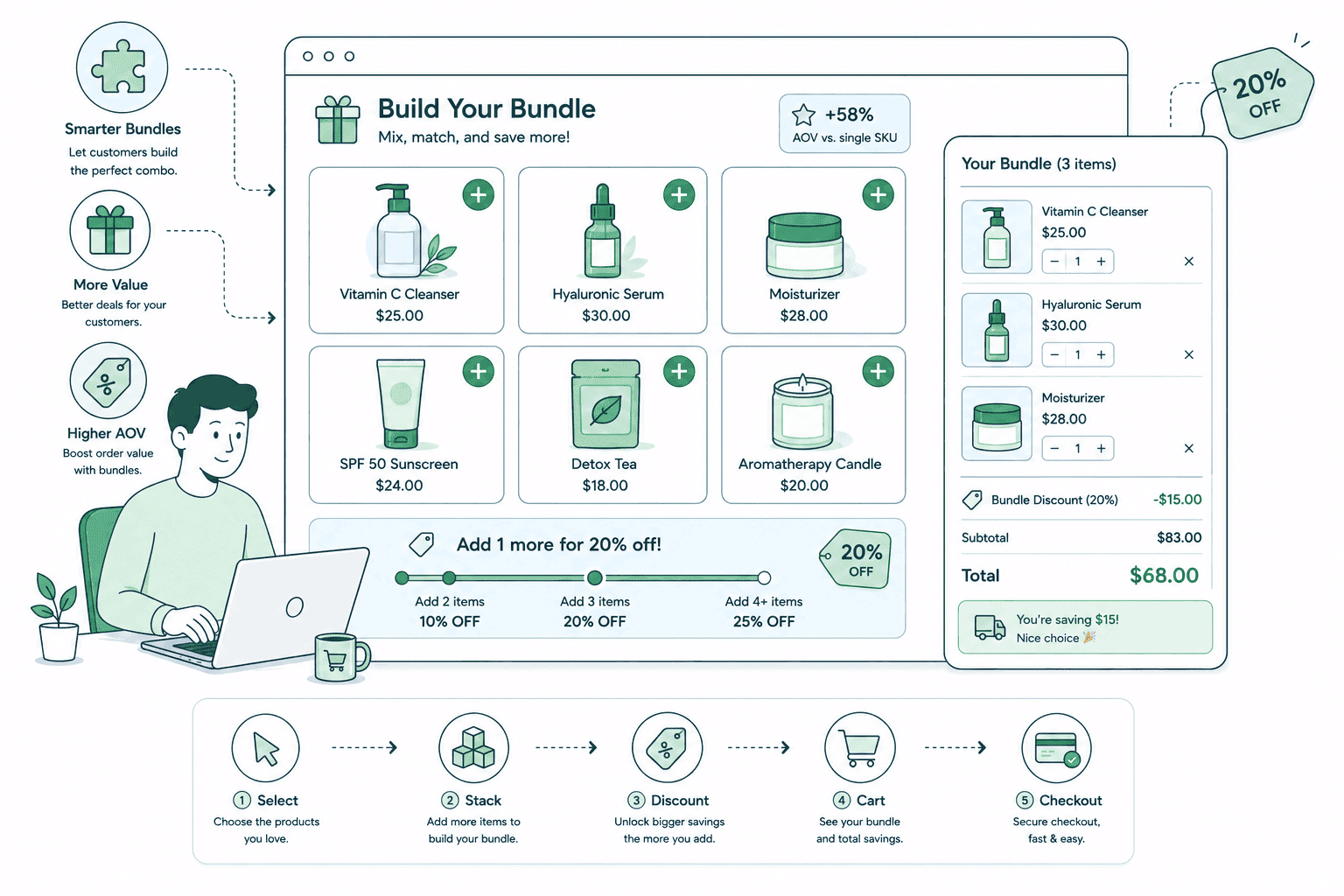
Why it matters
Bundling is a pricing decision that happens to need code.
In Shopify's funnel model — awareness, consideration, conversion, checkout, retention — bundles operate at the conversion stage: they change what the customer puts in the basket while they are still deciding, rather than adding to an order after it's placed. That timing is the advantage, and also the risk. A bundle discount is real money off products you were already selling, so the honest question is never 'will this raise AOV' — it usually will — but 'does the extra volume cover the margin we just gave away, and how much of it came from customers who would have paid full price anyway'. We model that before designing a builder.
Sound familiar?
Bundling looks free. The maths usually says otherwise.
Every one of these is fixable — but they get found by opening a spreadsheet, not by installing another bundle app.
- Your average order value sits close to your single-item price, and most orders contain one thing.
- You launched a bundle at thirty per cent off and never checked what it did to full-price sales.
- Your bundle is a separate SKU, so component stock and bundle stock drift apart every week.
- You think a bundle discount pays for itself because the customer spends more overall.
- Two products get bought together constantly and you've never packaged them as a set.
- You want build-your-own, but your app charges per order and controls your cart markup.
What's included
What a bundle funnel includes
The right mechanic for your catalogue, priced against margin, with inventory and full-price sales watched afterwards.
Native Bundles, app or custom
Shopify's own Bundles app handles fixed and mix-and-match sets, keeps component inventory in sync, and needs no third-party cart interference — but it stops short at complex pricing rules and subscription products. Apps go further and charge for it. Custom builds win when the logic is genuinely yours. We pick on your requirements, not our preference.
Mix-and-match and build-your-own
Pick any three, choose your own six, build a starter kit from these categories. These convert well because the customer designs the outcome, but they multiply the states you have to handle: partial selections, out-of-stock components, minimum quantities, and a cart that must explain what's in the box at a glance.
Volume and tiered pricing
Buy two save ten, buy three save more. Simpler to build than a builder, easier to explain, and often the better first move for consumables and refills. The design work is in the tier gaps — too shallow and nobody moves up, too steep and you have discounted your most loyal repeat buyers for nothing.
Inventory and SKU consequences
Bundles either consume component stock or create a separate SKU that drifts from it. The first needs correct decrementing across every channel; the second needs someone reconciling it weekly, forever. Add variants and a build-your-own mechanic and the SKU count grows fast. We choose the approach your operations can actually carry.
Discount depth against perceived value
Perceived value comes from the combination making obvious sense, not from the percentage. A well-composed kit at ten per cent off often outperforms a random trio at thirty, because the customer wanted the set. We set depth from margin data and adjust for how coherent the bundle reads, rather than defaulting to a round number.
Margin and cannibalisation checks
We track full-price unit sales alongside bundle revenue, before and after launch. If bundle sales climb while single-unit sales fall by a similar volume, you have moved the same customers onto a lower margin. That is the failure mode nobody reports, because the AOV chart looks excellent throughout.
How it runs
How we build a bundle funnel.
Two to four weeks per mechanic. The first week is spreadsheets — if the numbers don't work, no amount of front-end craft rescues it.
- 01
Check the maths first
Unit margins, current attach rates and what already gets bought together. We model the discount depth against contribution per order and set a floor. If a bundle only works at a depth you can't afford, we say so here.
- 02
Choose the mechanic
Fixed set, mix-and-match, build-your-own or volume tiers — matched to catalogue size, margin structure and what your operations team can pick and pack without errors. Simpler mechanics win more often than merchants expect.
- 03
Build and reconcile stock
We build on native Bundles, an app or custom code as the requirements dictate, then test component decrementing, partial availability and returns of part-bundles across every sales channel you run.
- 04
Watch full-price sales
After launch we compare bundle revenue against single-unit volume over matched windows, plus refunds and margin per order. If the bundle is quietly cannibalising full-price sales, we reprice or retire it.
3
Ways to build
Native, app or custom
0
Guessed discounts
Depth modelled on margin
2–4 wks
Build time
Per bundle mechanic
1
Margin floor
Agreed before design starts
Straight answer
Bundles are the wrong tool more often than the AOV charts suggest.
A good fit if…
- Your products have genuine affinity — people already buy them together without being prompted.
- You know your unit margins well enough to set a discount floor before anything is designed.
- Your catalogue supports a routine: a starter set, a refill cycle, a kit people repeat.
- Operations can handle component stock, picking, packing and returns of part-bundles without breaking.
Probably not, if…
- You want bundles to shift dead stock. Customers notice, and your good product carries the blame.
- Margins are thin enough that any discount deep enough to motivate makes the bundle unprofitable.
- Nobody tracks full-price unit sales, so cannibalisation would stay invisible to you indefinitely.
- Your inventory data is already unreliable — bundling multiplies every stock problem you have.
Keep exploring
More on Shopify funnels
Bundle & High-AOV Funnels is one part of the funnel types we build. Here's the rest of the picture.
Shopify CRO & Funnels
The complete service — every funnel type, built native to Shopify and measured.
View the serviceClosely relatedPost-Purchase Upsell Funnels
The after-payment route to a bigger order — one-click offers that can't cost you the sale.
Read the guideClosely relatedDTC Product Funnels
Single-product landing pages built to sell one thing properly, bundle offer included.
Read the guideAll guides in this series
- Quiz & Personalisation FunnelsTurn 'which one do I need' into a recommendation and a zero-party data capture.
- Subscription FunnelsConvert one-off buyers to recurring, and keep them past the third billing cycle.
- Lead-Generation FunnelsCapture the 97% who leave without buying, with an offer worth an email address.
- B2B & Wholesale FunnelsQuote requests, account applications and price lists — a buying process, not a cart.
- VSL & Long-Form Sales FunnelsVideo and long-form pages for considered purchases that a product page can't carry.
Beyond this service
Other things we do
Most stores need two or three of these working together. Book a call and we'll tell you which ones actually move your numbers.
- Shopify Theme DevelopmentCustom themes built from Figma to production Liquid on Online Store 2.0 — fast and merchant-editable.
- Shopify App DevelopmentCustom and public apps, Checkout UI Extensions and Shopify Functions built with React and Polaris.
- Shopify MigrationMove from WooCommerce, Magento or BigCommerce with a full 301 redirect map and zero downtime.
- Shopify SEOTechnical audits, Core Web Vitals, structured data and collection content built around buyer intent.
- Shopify Performance OptimizationFaster load times and green Core Web Vitals — theme refactors, image pipelines and app cleanup.
- Shopify A/B TestingHypothesis-led experiments on product pages and checkout, shipped as native theme code.
- Shopify Email Marketing & KlaviyoFlows, segmentation and campaigns — welcome, abandoned cart, winback and SMS, built and monitored.
- Shopify CRO & FunnelsValue-ladder, tripwire, quiz and post-purchase upsell funnels built to lift conversion and AOV.
- Shopify Maintenance & SupportRetainers covering uptime monitoring, security patching, bug fixes and proactive improvements.
Frequently asked questions
- Start with Shopify's native Bundles app: it covers fixed and mix-and-match sets, keeps component inventory synced, and doesn't inject third-party code into your cart. Move to an app when you need mechanics it doesn't support, and to a custom build when the pricing logic is genuinely specific to your business, when per-order app fees stop making sense at your volume, or when the app's cart takeover is hurting performance.
Thinking about bundles?
Book a 30-minute call. We'll look at your margins and what already gets bought together, and tell you whether a bundle earns its discount on your catalogue.
Book a free call