Shopify Content & Copy Update Support
Campaign pages, seasonal banners, homepage swaps, collection copy and new landing pages — built quickly and correctly. But the more useful version of this service is the one that puts most of that work back in your own team's hands and takes us out of the loop.
Book a Free Technical Call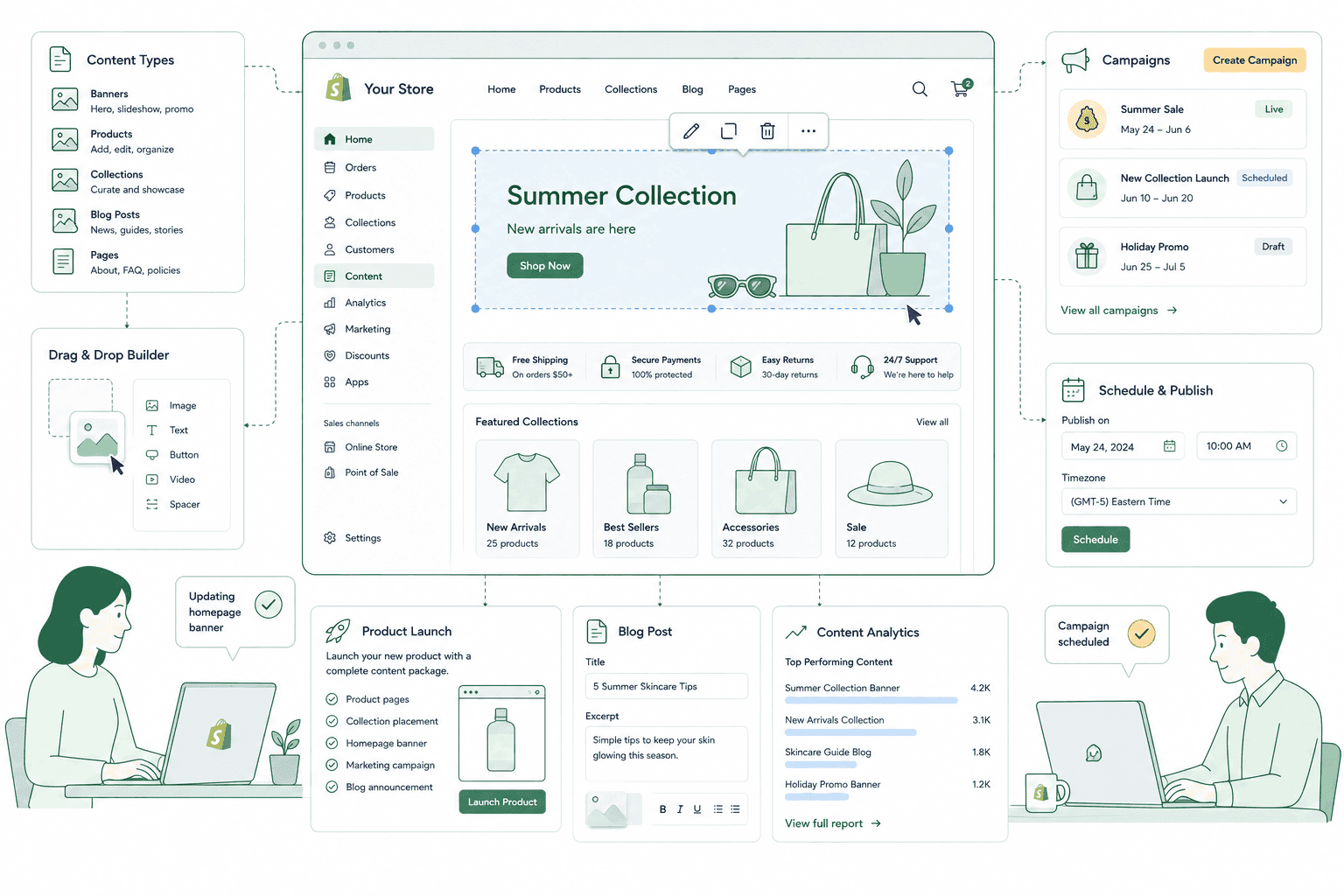
Why it matters
If you're paying an agency to swap a banner, the theme was built wrong.
Online Store 2.0 exists precisely so that merchandising decisions don't need a deployment. Sections can be added, reordered and removed on any template. Blocks let a marketer restructure a page. Metafields hold structured product content that renders wherever it's referenced. A theme built to use those properly means your team changes the homepage hero on a Friday afternoon without a ticket, a quote or a release window. A theme that hard-codes copy into Liquid means every seasonal change is a developer job forever — and you pay for that decision every month, not once. So we will do your content updates. We'd just rather fix the reason you need us to.
Sound familiar?
Marketing waits on a developer to change a headline.
Any of these means the bottleneck is the theme, not the team. One item below is an assumption we hear often — and it's the one costing you the most.
- Your marketer has to raise a ticket to change the homepage hero image before a sale.
- Campaign banners go live late because the person who can publish them was unavailable.
- You assume every content change needs a developer, so nobody has tried the theme editor.
- The same product information is typed into forty descriptions and is wrong in half of them.
- Nobody edits collection descriptions because the field is buried and nothing renders on mobile.
- Last season's landing pages are still live because deleting them felt risky to everyone.
What's included
What content support actually covers
Two halves: the work we do for you now, and the theme changes that mean you stop needing us for most of it.
Campaign and seasonal work
Homepage hero swaps, sale banners, promotional blocks, countdown messaging, gift guides and seasonal collection presentation — scheduled ahead of the date rather than published in a rush the night before. Assets sized correctly so a campaign doesn't cost you your Core Web Vitals.
Collection and product copy
Collection descriptions, category intros, size and care information, shipping and returns messaging, and product content that needs to read consistently across a range. Placed in fields that render properly on mobile rather than pasted into a rich-text box and hoped for.
Sections your team controls
Where you keep asking us for the same change, we build it as a configurable section instead. Text, image, link, layout and visibility exposed as settings in the theme editor, so the next version of that request takes your marketer two minutes and costs nothing.
Metafields and structured content
Content that repeats across products — ingredients, dimensions, care instructions, certifications, fit notes — modelled as metafield definitions rather than typed into descriptions. Entered once per product, rendered consistently everywhere, and filterable and searchable as a result.
New templates and custom sections
The work that genuinely needs a developer: a new template type for a product family, a landing page layout the theme has no section for, conditional logic, or a component that pulls from an external source. Built to the same standard as the rest of the theme, not bolted on.
SEO hygiene on every change
Heading structure kept sane, image alt text written, internal links pointing somewhere useful, and redirects created when a campaign URL is retired. Most ranking damage from content work comes from deleted pages and orphaned URLs, not from the copy itself.
How it runs
How content work runs.
Standard requests turned around in one to two working days, with campaign work scheduled a week ahead — and a standing rule that any request made three times gets built as a setting instead.
- 01
Take the request
Copy, assets and the date it needs to be live, in one place. We flag anything that's actually a build — a new template or custom section — before it goes into the content queue.
- 02
Decide who should own it
If the theme already supports the change, we show your team where and how. If it doesn't but should, we quote the section or metafield work instead of quietly billing the manual version forever.
- 03
Build and preview
Done on a duplicate theme with a preview link, checked on mobile first, images compressed and sized. You approve what you can actually see rather than a description of it.
- 04
Publish and tidy up
Scheduled to the agreed date, then the cleanup nobody remembers: retiring the last campaign, redirecting dead URLs and removing sections left disabled on the template.
0
Developers needed
For a properly built OS 2.0 theme
1–2
Days per request
Standard content turnaround
3
Repeats, then it's a setting
We stop doing it manually
Metafields
Over pasted copy
Entered once, rendered everywhere
Straight answer
We'd rather build you out of this service than bill you for it.
A good fit if…
- You run frequent campaigns and need someone reliable to build the pages behind them.
- Your product content is unstructured and you want it modelled into metafields properly.
- You need new template types or custom sections the current theme genuinely cannot express.
- You want your marketing team editing the store, and need the theme changed to allow it.
Probably not, if…
- You only need banner swaps. Fix the theme once instead of paying for that every month.
- Your team can already do this in the theme editor and just hasn't been shown how.
- You want copywriting and content strategy — we build and publish, we don't write your brand.
- You need daily publishing at volume. That's an in-house merchandiser, not an agency retainer.
Keep exploring
More on Shopify maintenance
Content & Copy Updates is one part of what an ongoing Shopify retainer covers. Here's the rest of the picture.
Shopify Maintenance & Support
The complete retainer — monitoring, patching, fixes and the reporting behind them.
View the serviceClosely relatedBug Fixes & Quick Wins
The other half of the queue — small broken things, triaged by revenue impact.
Read the guideClosely relatedApp & Theme Updates
Updates tested on a duplicate first, so a release doesn't undo your content work.
Read the guideAll guides in this series
- Uptime Monitoring & Incident ResponseShopify rarely goes down. Your theme, apps and DNS are a different story.
- Security & Vulnerability PatchingShopify secures the platform. Your apps, staff access and custom code are yours.
- Backups & Disaster RecoveryShopify does not back your store up for you. Most merchants find out too late.
- Analytics & Monthly ReportingA report that names what changed and what it did, not a dashboard screenshot.
- Quarterly Strategy ReviewsDeciding what to build next quarter, and what to stop paying for.
Beyond this service
Other things we do
Most stores need two or three of these working together. Book a call and we'll tell you which ones actually move your numbers.
- Shopify Theme DevelopmentCustom themes built from Figma to production Liquid on Online Store 2.0 — fast and merchant-editable.
- Shopify App DevelopmentCustom and public apps, Checkout UI Extensions and Shopify Functions built with React and Polaris.
- Shopify MigrationMove from WooCommerce, Magento or BigCommerce with a full 301 redirect map and zero downtime.
- Shopify SEOTechnical audits, Core Web Vitals, structured data and collection content built around buyer intent.
- Shopify Performance OptimizationFaster load times and green Core Web Vitals — theme refactors, image pipelines and app cleanup.
- Shopify A/B TestingHypothesis-led experiments on product pages and checkout, shipped as native theme code.
- Shopify Email Marketing & KlaviyoFlows, segmentation and campaigns — welcome, abandoned cart, winback and SMS, built and monitored.
- Shopify CRO & FunnelsValue-ladder, tripwire, quiz and post-purchase upsell funnels built to lift conversion and AOV.
- Shopify Maintenance & SupportRetainers covering uptime monitoring, security patching, bug fixes and proactive improvements.
Frequently asked questions
- For most of them, yes — and if they can't, that's a fault in the theme rather than in your team. Online Store 2.0 lets sections be added, reordered and configured on any template, and metafields let structured product content be entered once and rendered anywhere. A theme built to use those means your marketer changes a hero, reorders the homepage or swaps a banner without involving a developer. If every change currently needs us, the honest recommendation is to fix the theme once instead of billing you monthly for the consequence.
Waiting on a developer to change a banner?
Book a 30-minute call. We'll look at your theme and tell you how much of your content queue your own team could be handling.
Book a free call