Shopify Local SEO
If you trade from shops, a showroom or a service radius, local search behaves like a separate channel with its own ranking rules, its own results layout and its own conversion path — often a phone call or a walk-in rather than a checkout. We build that layer properly: Business Profiles, location pages, citations, LocalBusiness schema and reviews, tied back to the store.
Book a Free Technical Call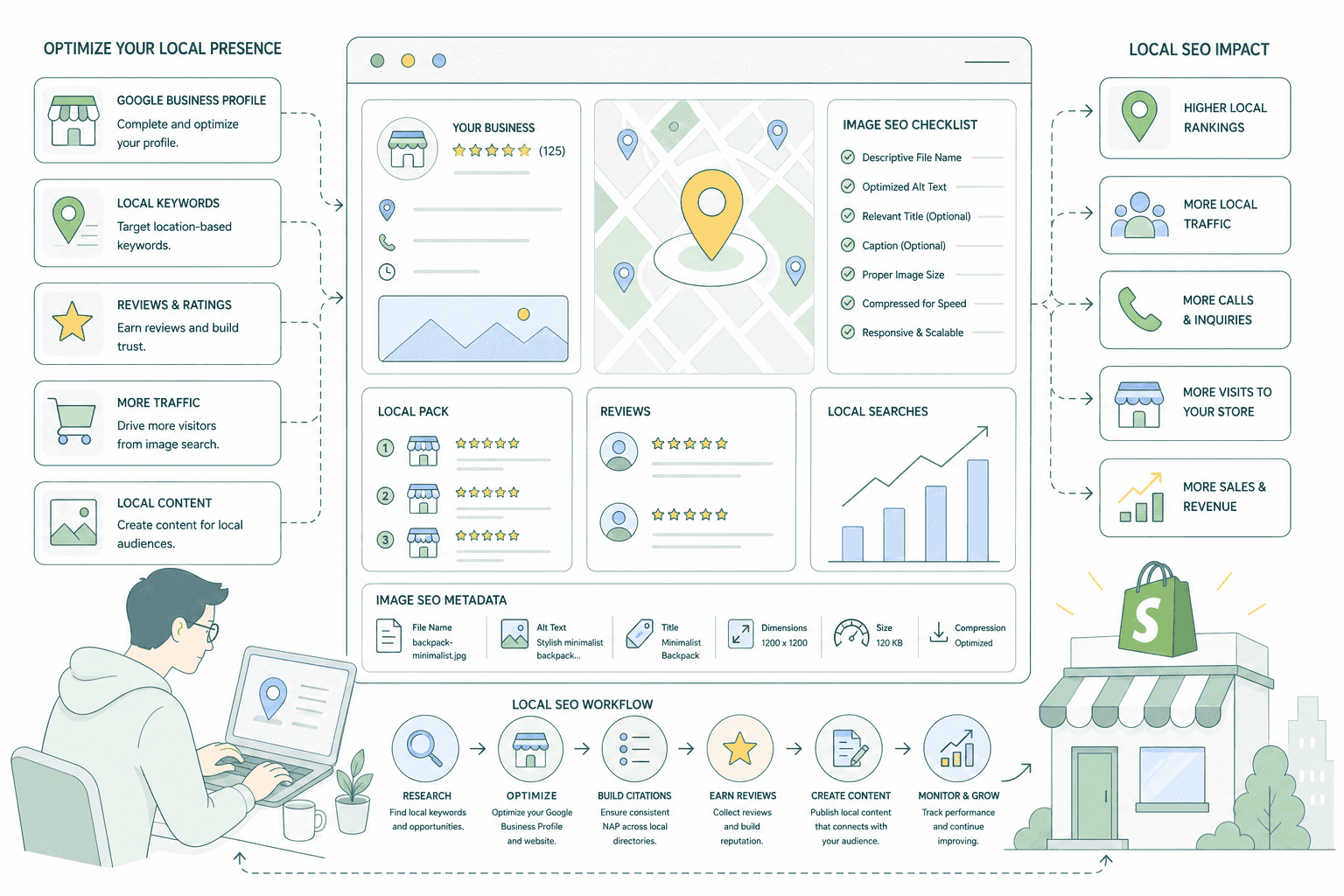
Why it matters
Most Shopify merchants don't need local SEO at all.
Local search is a genuinely different discipline. Proximity is a ranking factor, the map pack sits above the organic results, and a verified Google Business Profile does more for you than any amount of on-page work. That matters enormously if you have shops, a showroom, a warehouse people collect from, or engineers who drive to customers. It matters not at all if you ship nationally from a single fulfilment centre — in that case there is nothing to be local about, and the honest recommendation is to spend the budget on collection pages, buying-guide content and technical fixes instead. We'd rather tell you that in the first call than sell you a citation package you don't need.
Sound familiar?
Local SEO is the fastest-selling service in ecommerce and the least often needed.
Some of these mean you have real local demand going unclaimed. One of them means someone is about to sell you the wrong thing. Read them honestly.
- You run one or more physical shops, and people still ring to ask whether you have something in stock.
- Your Google Business Profile was claimed years ago by an employee who has since left the business.
- You sell nationally from one warehouse, and someone has told you local SEO will help. It won't.
- Your address, phone number or trading hours differ between your site, your profile and old directory listings.
- You opened a second location, and that suburb returns your competitors for every “near me” search.
- Your best reviews sit on your product pages while your Business Profile has eleven, two of them angry.
What's included
What local SEO covers
Six pieces of work, each of which only earns its place if you have a real physical footprint.
Google Business Profile
Claimed, verified and owned by someone still at the company. Correct primary and secondary categories, trading hours including public holidays, services, attributes and products, plus the photo and post cadence that keeps a profile active. For most local merchants this single asset outperforms everything else on this list.
Location landing pages
A real page per location — address, embedded directions, parking, staff, stock highlights, opening hours and the actual reason to visit that shop. Not one “Our Stores” page with a list, and not the same 400 words with the suburb name swapped out, which Google has been discounting for years.
NAP and citation consistency
Name, address and phone number matched exactly across your site, Google, Apple Maps, Bing Places and the directories that still carry weight in your market. We audit what already exists, correct the wrong entries and kill the duplicates — old listings from a previous address do more damage than missing ones.
LocalBusiness schema
LocalBusiness or the correct sub-type on every location page, with geo coordinates, openingHoursSpecification, areaServed and sameAs links to your profiles. Implemented in the theme so it stays accurate when hours change, and validated in the Rich Results Test rather than assumed to be working.
Reviews that count
Review volume and recency influence map pack placement, and review text feeds the queries you surface for. We set up a request flow that reaches customers at the right moment, keeps it compliant, and routes it to the Business Profile — not just to the on-site widget where Google can't read it.
Store locator and POS bridge
A crawlable locator with an indexable page per store, plus in-store stock, click-and-collect and local delivery surfaced where a nearby shopper will see them. If you run Shopify POS, the aim is one set of hours and inventory feeding the site, the locator and your profiles.
How it runs
How the work actually runs.
Four to six weeks of setup, then a light monthly rhythm. Map pack movement usually shows within a quarter — faster than organic, because proximity and profile signals respond quickly.
- 01
Confirm you need this
We look at where your revenue actually comes from, whether your queries carry local intent, and how much traffic your locations could realistically claim. If the answer is that you're a national shipper, we say so and stop.
- 02
Audit the footprint
Every profile, listing and citation that mentions your business, including the ones you forgot. We map duplicates, wrong addresses and dead phone numbers, then rank the fixes by how much damage each one is doing.
- 03
Build the local layer
Business Profiles optimised, location pages written and shipped in the theme, LocalBusiness schema implemented and validated, citations corrected, and the review request flow connected so it keeps running without you.
- 04
Track and maintain
Map pack positions by location, profile calls, direction requests and store visits reported against the pages we built. Hours, seasonal closures and new locations get maintained — a stale profile decays quickly.
1 page
Per location
Not one shared list
NAP
One source of truth
Site, profile, citations
Schema
LocalBusiness
Validated, not assumed
POS
Stock and hours
In-store and online aligned
Straight answer
This is the page on our site most likely to be the wrong service for you.
A good fit if…
- You trade from one or more physical shops, showrooms or warehouses that customers visit in person.
- You serve a defined geographic radius — installation, fitting, repairs, delivery or on-site work.
- You run Shopify POS and want in-store stock and hours reflected accurately in local results.
- You're opening new locations and want each one to rank in its own suburb from day one.
Probably not, if…
- You ship nationally from one fulfilment centre. There is no local signal to build, and no map pack to enter.
- You're purely online and want to rank for “near me” terms anyway. That isn't something we can honestly sell you.
- You have no physical address you're willing to publish. Google verification requires one, and PO boxes fail.
- Your real problem is that collection pages don't rank nationally. Technical and on-page work fixes that, not this.
Keep exploring
More on Shopify SEO
Local SEO is one part of how we do Shopify SEO. Here's the rest of the picture.
Shopify SEO
The complete service — technical, on-page, content and reporting, in one engagement.
View the serviceClosely relatedSchema Markup & Rich Results
LocalBusiness is one type among many — here's the full structured data picture.
Read the guideClosely relatedOn-Page SEO
What actually makes a location or collection page worth ranking once it exists.
Read the guideAll guides in this series
- Technical SEO AuditCrawling, indexing, canonicals and the structural faults holding the store back.
- Keyword ResearchBuyer-intent keywords mapped to the collection and product pages that can win them.
- Content & Blog SEOBuying guides and comparison content that pull traffic your collections can't.
- Image SEOAlt text, file naming and image sitemaps — Google Images is a real channel for retail.
- SEO Reporting & TrackingSearch Console, GA4 and rank tracking wired to revenue, not vanity positions.
Beyond this service
Other things we do
Most stores need two or three of these working together. Book a call and we'll tell you which ones actually move your numbers.
- Shopify Theme DevelopmentCustom themes built from Figma to production Liquid on Online Store 2.0 — fast and merchant-editable.
- Shopify App DevelopmentCustom and public apps, Checkout UI Extensions and Shopify Functions built with React and Polaris.
- Shopify MigrationMove from WooCommerce, Magento or BigCommerce with a full 301 redirect map and zero downtime.
- Shopify SEOTechnical audits, Core Web Vitals, structured data and collection content built around buyer intent.
- Shopify Performance OptimizationFaster load times and green Core Web Vitals — theme refactors, image pipelines and app cleanup.
- Shopify A/B TestingHypothesis-led experiments on product pages and checkout, shipped as native theme code.
- Shopify Email Marketing & KlaviyoFlows, segmentation and campaigns — welcome, abandoned cart, winback and SMS, built and monitored.
- Shopify CRO & FunnelsValue-ladder, tripwire, quiz and post-purchase upsell funnels built to lift conversion and AOV.
- Shopify Maintenance & SupportRetainers covering uptime monitoring, security patching, bug fixes and proactive improvements.
Frequently asked questions
- No, and we won't take the work. Local rankings are driven by a verified physical address, proximity to the searcher and a Google Business Profile. Without a location people can visit, there's nothing to verify and no map pack to enter. Merchants who ship nationally get far more from technical fixes, better collection pages and buying-guide content. Anyone selling you “local SEO” for a warehouse-only operation is selling you citations you'll never benefit from.
Not sure local applies to you?
Book a 30-minute call. We'll look at where your revenue comes from and tell you honestly whether local search is worth a penny of your budget.
Book a free call