Shopify Image SEO
Retail is a visual category, and image search is where a large share of product discovery starts — in Google Images, and increasingly through Lens pointed at something in the real world. Winning there needs descriptive alt text at catalogue scale, file names that mean something, and images Google can actually find and attribute to a product.
Book a Free Technical Call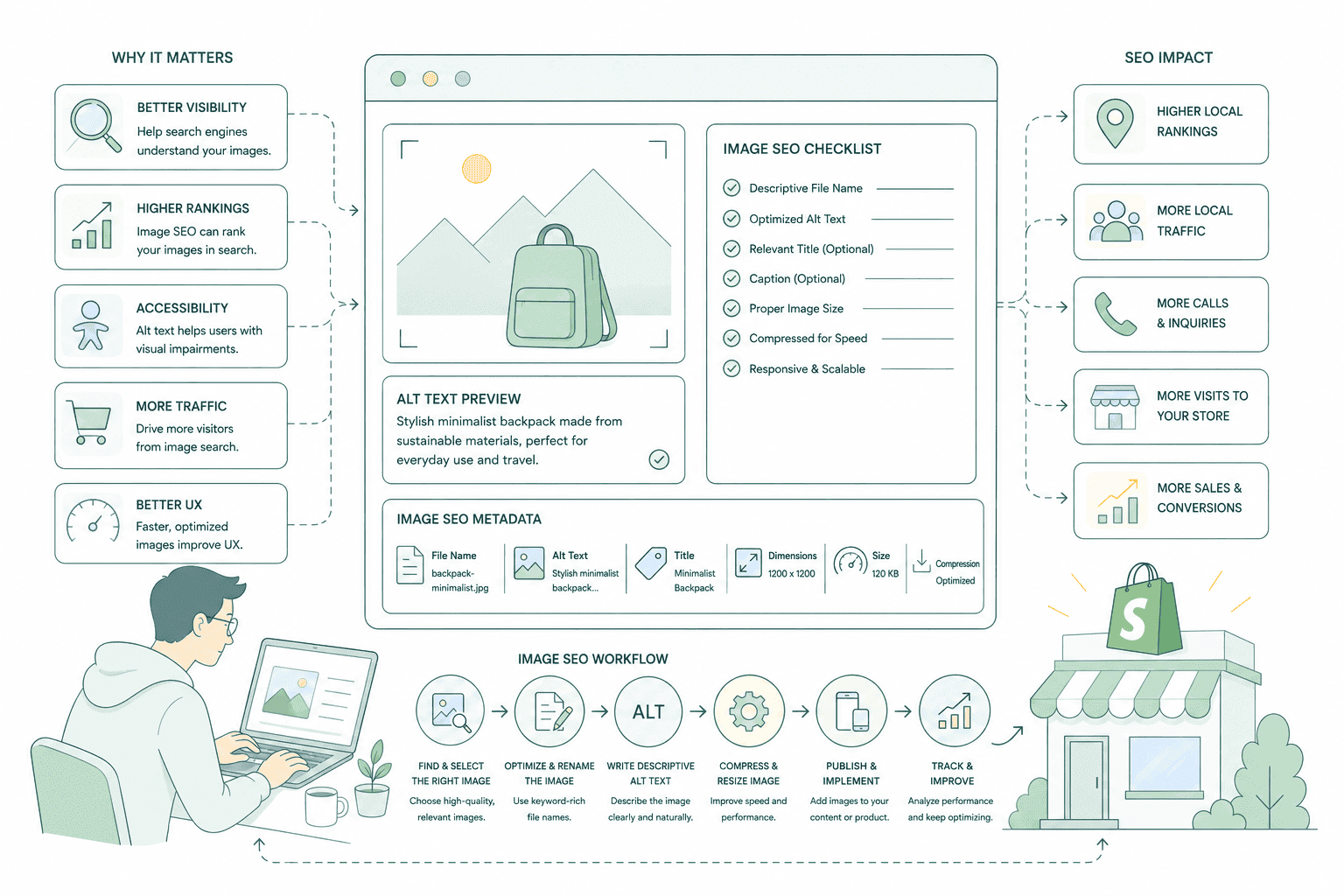
Why it matters
Google Images is a retail channel almost nobody in Shopify contests.
Open a typical Shopify store's source and you'll find images named IMG_4471.jpg with alt text that repeats the product title forty times across the variant set — because the theme fills it automatically and nobody has ever changed it. Meanwhile people are photographing a chair in a friend's house with Lens and buying whichever store Google can confidently match. That match depends on signals most merchants never supply: what the image genuinely shows, a file name that corroborates it, an image Google is permitted to crawl and index, and product markup that binds the image to a real item with a price. None of this is difficult work. It's just tedious at catalogue scale, which is exactly why it stays undone and why the ground is still open.
Sound familiar?
Alt text is the one SEO task an entire team quietly agrees is somebody else's job.
It's invisible from the storefront, tedious at scale, and split between marketing, merchandising and whoever uploads the products. So it never gets done, on any store, ever.
- Every image on a product page carries alt text identical to the product title, repeated across all variants.
- Your image files are named IMG_4471.jpg and DSC_0092.jpg, straight off the photographer's memory card.
- You assume alt text is purely an accessibility checkbox with no bearing on search at all.
- Competitor products fill Google Images for your category terms and yours appear nowhere in them.
- Your lifestyle photography is genuinely good and completely undescribed to anyone who can't see it.
- Somebody bulk-filled alt text with keyword strings, and it now reads as spam to screen readers.
What's included
What image SEO covers
A rules-based pass across the whole catalogue, not a hundred images edited by hand and the rest left as they were.
Alt text at catalogue scale
Alt text that describes what's genuinely in the frame — the product, its colourway, the angle, the context — rather than repeating the product title on every image. We define patterns per template and per image role, so a 4,000-SKU catalogue gets consistent, useful descriptions without anyone typing 12,000 of them individually.
File names that mean something
The uploaded file name becomes part of the Shopify CDN URL, and it's one of the few durable signals about an image's subject. We set a naming convention — product, variant, view — and apply it going forward, then judge case by case whether re-uploading historic images is worth losing their existing URLs.
Image sitemaps and indexing
Shopify's product sitemap includes image entries, but plenty of images live outside it: collection banners, blog imagery, theme assets, anything served by an app. We check what's genuinely indexed against what should be, fix robots and crawl rules blocking access, and confirm coverage in Search Console.
Structured data on product images
Product markup carries an image property, and getting it right is how Google binds a picture to a specific item, price and availability. Absolute URLs, the right aspect ratios, the primary image first, and every variant image associated with the variant it actually depicts rather than the parent product.
Built for Google Lens
Lens matches on the image itself, so the practical work is making sure your catalogue includes clean product-on-white shots as well as in-context lifestyle images, both properly described and indexable. Distinctive physical products — furniture, fashion, homewares — benefit most, and that's worth knowing before you invest.
Responsive delivery, briefly
We'll confirm images are served through Shopify's CDN with sensible srcset breakpoints and modern formats, because a broken responsive setup undermines everything above it. That's the extent of it here — image weight, lazy loading and Core Web Vitals belong to our performance work, not to this engagement.
How it runs
How the catalogue actually gets fixed.
Three to four weeks for a mid-sized catalogue: rules first, then a bulk pass, then a standard your team can hold to without us.
- 01
Audit the catalogue
We crawl every indexable image and record its alt text, file name, dimensions and whether Google has it indexed. The output is a spreadsheet showing exactly how much is duplicated, empty, auto-filled or keyword-stuffed.
- 02
Write the rules
We define alt text patterns per image role — primary, variant, detail, lifestyle — and a file naming convention. Rules matter more than individual copy here, because rules are what a team can still apply in eighteen months.
- 03
Run the bulk pass
Alt text is applied across the catalogue via the Admin API using the agreed patterns, with human review on top-selling and high-traffic products. New file names are applied to new uploads and to historic images only where it's justified.
- 04
Hand over the standard
You get the naming convention, the alt text patterns and a short checklist for whoever uploads products. Without that handover the catalogue drifts back within a season, and the whole exercise has to be repeated.
Written
Alt text
Not auto-filled from titles
Lens
Visual search
A live retail surface
Indexed
Image coverage
Verified in Search Console
Rules
Handed over
So it doesn't drift back
Straight answer
Image SEO pays off for visually distinctive products. For everything else it's marginal.
A good fit if…
- You sell visually distinctive goods — furniture, fashion, homewares, jewellery — that people search by look.
- Your photography is genuinely good and currently invisible to anything that can't see it.
- You have accessibility obligations and want one piece of work to serve both purposes properly.
- Your catalogue is large enough that a rules-based bulk pass beats editing products by hand.
Probably not, if…
- You sell commodity items nobody browses visually. Image search will never be a meaningful channel for you.
- Your product photography is poor. Fix the photography first — no amount of markup rescues bad images.
- You want this framed as a speed project. Image weight and Core Web Vitals are separate work entirely.
- You need clearly attributable revenue this quarter. Image discovery is upper-funnel and awkward to measure.
Keep exploring
More on Shopify SEO
Image SEO is one part of how we do Shopify SEO. Here's the rest of the picture.
Shopify SEO
The complete service — technical, on-page, content and reporting, in one engagement.
View the serviceClosely relatedOn-Page SEO
Images sit inside the wider on-page job — titles, headings and collection copy.
Read the guideClosely relatedContent & Blog SEO
Guides and comparisons are where your lifestyle photography earns its second life.
Read the guideAll guides in this series
- Technical SEO AuditCrawling, indexing, canonicals and the structural faults holding the store back.
- Keyword ResearchBuyer-intent keywords mapped to the collection and product pages that can win them.
- Schema Markup & Rich ResultsProduct, review, FAQ and breadcrumb structured data, implemented and validated.
- Local SEOFor stores with a physical presence — Business Profile, local pages and citations.
- SEO Reporting & TrackingSearch Console, GA4 and rank tracking wired to revenue, not vanity positions.
Beyond this service
Other things we do
Most stores need two or three of these working together. Book a call and we'll tell you which ones actually move your numbers.
- Shopify Theme DevelopmentCustom themes built from Figma to production Liquid on Online Store 2.0 — fast and merchant-editable.
- Shopify App DevelopmentCustom and public apps, Checkout UI Extensions and Shopify Functions built with React and Polaris.
- Shopify MigrationMove from WooCommerce, Magento or BigCommerce with a full 301 redirect map and zero downtime.
- Shopify SEOTechnical audits, Core Web Vitals, structured data and collection content built around buyer intent.
- Shopify Performance OptimizationFaster load times and green Core Web Vitals — theme refactors, image pipelines and app cleanup.
- Shopify A/B TestingHypothesis-led experiments on product pages and checkout, shipped as native theme code.
- Shopify Email Marketing & KlaviyoFlows, segmentation and campaigns — welcome, abandoned cart, winback and SMS, built and monitored.
- Shopify CRO & FunnelsValue-ladder, tripwire, quiz and post-purchase upsell funnels built to lift conversion and AOV.
- Shopify Maintenance & SupportRetainers covering uptime monitoring, security patching, bug fixes and proactive improvements.
Frequently asked questions
- Both, and the accessibility case is the stronger one. Alt text is what a screen reader announces, so writing it well is a genuine obligation before it's a tactic. For search, Google has said plainly that alt text is how it understands what an image depicts, which affects whether the image can surface in Google Images and how it interprets the page around it. The useful thing is that good accessibility copy and good SEO copy are the same copy: describe what's actually in the frame, in a sentence a person would say.
Catalogue full of undescribed images?
Book a 30-minute call. We'll sample your catalogue live, show you what Google can and can't currently see, and tell you if image search is worth contesting in your category.
Book a free call