Shopify Keyword Research
Most keyword research delivers a spreadsheet of terms sorted by search volume. That's the easy half. The work that matters is deciding which page type can realistically win each term, which terms are worth chasing at all, and which of your collections are competing with each other for the same phrase.
Book a Free Technical Call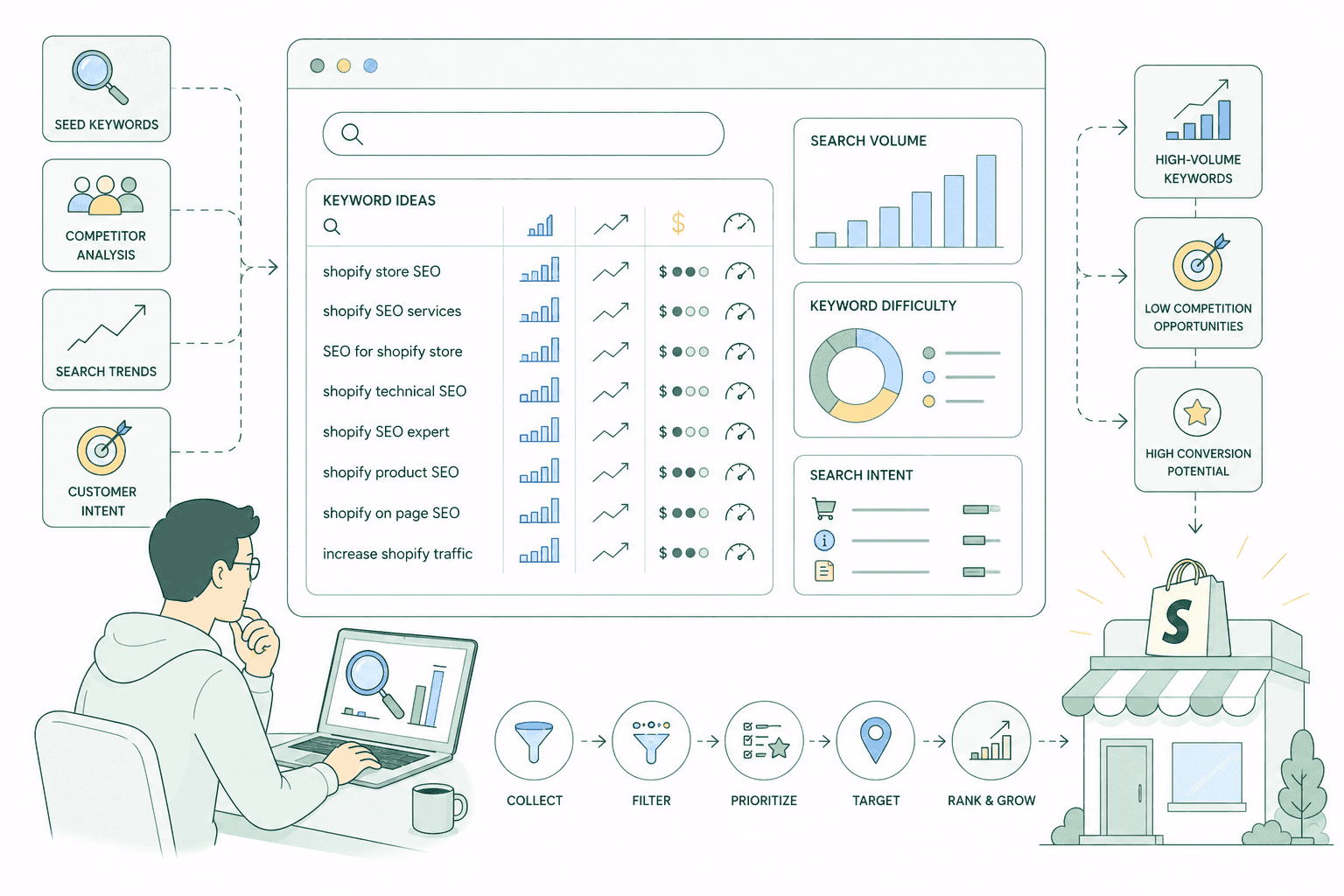
Why it matters
A keyword only counts once a specific page can realistically win it.
Shopify gives you three page types that can rank: collections, products and blog articles. Each one suits a different kind of query, and putting a term on the wrong template is the most common reason good research produces nothing. Broad category terms belong on collections, because that's what Google returns for them — a single product page almost never outranks a well-built category listing. Specific model and variant queries belong on products. Questions, comparisons and buying guides belong in content, and forcing them onto a collection page produces the block of grey text below the product grid that everyone recognises and nobody reads. Get the mapping wrong and you'll do months of on-page work against pages that were never eligible.
Sound familiar?
Volume is the least useful number in a keyword spreadsheet.
If any of these describe your store, the problem is usually mapping and intent rather than a shortage of keywords.
- You rank comfortably for your brand name and almost nothing a stranger would ever type.
- Two collections target the same phrase, and Google keeps swapping which one it shows.
- Your product pages are optimised for broad category terms only a collection could win.
- An agency handed you a keyword list, and nobody ever decided which page owned which term.
- You assume high volume means high value, so specific buying terms get ignored entirely.
- Competitors rank for questions your customers ask, and your store has nowhere to answer them.
What's included
What the research covers
A keyword set you can act on immediately — every term classified by intent, assigned to one URL, and checked against what actually ranks today.
Buyer-intent classification
Every term sorted by where the searcher is: comparing options, ready to buy, or still learning. Commercial terms get priority because they convert, but informational terms are how you reach people before a competitor does. Both matter — they just belong in different places and get measured differently.
Keyword-to-template mapping
Each term assigned to a collection, a product page or an article, based on what Google currently returns for that query rather than what you'd prefer. If the results page is full of category listings, a product page won't win it, and we'll say so before you spend money finding out.
Cannibalisation audit
Stores accumulate near-duplicate collections — by type, by tag, by campaign — that all target the same phrase. Google picks one, often inconsistently, and neither page builds momentum. We find these overlaps and recommend which page keeps the term and what happens to the others.
Long-tail and modifier terms
Material, size, colour, use case, price band, compatibility, occasion. These queries have modest volume individually and much clearer purchase intent, and they map cleanly onto filtered collections or dedicated landing pages. In competitive categories they're often the only realistic entry point.
Competitor gap analysis
Which terms your direct competitors rank for that you don't, and which of those gaps you could plausibly close. We separate the ones held by a page you could beat from the ones held by a retailer with a decade of authority — chasing the second group is how budgets disappear.
A mapped, prioritised set
The deliverable is one term per URL, ordered by commercial value and how hard the current results look. It's a working document your on-page, content and reporting work all reference — not a 3,000-row export nobody opens twice.
How it runs
How the research runs.
Two to four weeks depending on catalogue size and how many competitors are worth analysing, with the intent framework agreed in the first week so nothing gets built on a wrong assumption.
- 01
Understand the catalogue
How your products are categorised, which collections exist and why, what your margins look like, and which lines you actually want to sell more of. Keyword priority should follow commercial priority, not the other way round.
- 02
Build and classify
Seed terms expanded from Search Console, competitor rankings and Shopify's own site search data — which tells you what buyers already on your store couldn't find. Everything is then classified by intent and stage.
- 03
Check the live results
For every priority term we look at what currently ranks. That tells us the page type Google expects, how strong the incumbents are, and whether the term is realistically winnable within a sensible timeframe.
- 04
Map and prioritise
Each term is assigned to exactly one URL — existing or to be created — and overlaps between collections are resolved. You get an ordered plan showing what to work on first and what to leave alone.
Intent
Sorted first
Commercial vs informational
1:1
Term to URL
No two pages, one keyword
SERP
Checked live
What ranks, not what should
Gap
Competitor set
Terms they hold, you don't
Straight answer
Keyword research isn't always what a store needs first.
A good fit if…
- You have enough products or collections that deciding what targets what is genuinely hard.
- Organic traffic is flat and you can't tell whether the cause is targeting or execution.
- You're planning new collections or content and want the structure decided before anyone builds it.
- You have the resource to act on the mapping — in-house, with us, or with your developers.
Probably not, if…
- Your indexing is broken. Fix crawling and canonicals first, or the mapping goes nowhere.
- You want a list of keywords and nothing else. We only sell this alongside implementation.
- You expect us to name the traffic figure you'll reach. That number cannot be honestly forecast.
- You sell a handful of products in a niche with almost no search demand. Paid may serve you better.
Keep exploring
More on Shopify SEO
Keyword Research is one part of how we do Shopify SEO. Here's the rest of the picture.
Shopify SEO
The complete service — technical, on-page, content and reporting, in one engagement.
View the serviceClosely relatedOn-Page SEO
Where the mapped keywords actually get used — titles, headings, copy and internal links.
Read the guideClosely relatedContent & Blog SEO
For the informational terms no collection page can sensibly answer.
Read the guideAll guides in this series
- Technical SEO AuditCrawling, indexing, canonicals and the structural faults holding the store back.
- Schema Markup & Rich ResultsProduct, review, FAQ and breadcrumb structured data, implemented and validated.
- Image SEOAlt text, file naming and image sitemaps — Google Images is a real channel for retail.
- Local SEOFor stores with a physical presence — Business Profile, local pages and citations.
- SEO Reporting & TrackingSearch Console, GA4 and rank tracking wired to revenue, not vanity positions.
Beyond this service
Other things we do
Most stores need two or three of these working together. Book a call and we'll tell you which ones actually move your numbers.
- Shopify Theme DevelopmentCustom themes built from Figma to production Liquid on Online Store 2.0 — fast and merchant-editable.
- Shopify App DevelopmentCustom and public apps, Checkout UI Extensions and Shopify Functions built with React and Polaris.
- Shopify MigrationMove from WooCommerce, Magento or BigCommerce with a full 301 redirect map and zero downtime.
- Shopify SEOTechnical audits, Core Web Vitals, structured data and collection content built around buyer intent.
- Shopify Performance OptimizationFaster load times and green Core Web Vitals — theme refactors, image pipelines and app cleanup.
- Shopify A/B TestingHypothesis-led experiments on product pages and checkout, shipped as native theme code.
- Shopify Email Marketing & KlaviyoFlows, segmentation and campaigns — welcome, abandoned cart, winback and SMS, built and monitored.
- Shopify CRO & FunnelsValue-ladder, tripwire, quiz and post-purchase upsell funnels built to lift conversion and AOV.
- Shopify Maintenance & SupportRetainers covering uptime monitoring, security patching, bug fixes and proactive improvements.
Frequently asked questions
- You can, and for a small catalogue you probably should. Tools are good at producing terms and volume estimates. What they can't do is tell you which of your existing collections should own a phrase, whether two of your pages are already fighting over it, or whether the current results page is winnable at all. That judgement is the part we're actually charging for.
Got a keyword list nobody uses?
Book a 30-minute call. Bring it along — we'll tell you which terms are worth keeping and which pages should own them.
Book a free call